Transforming recovery after limb loss
Testing a remouldable prosthetic socket designed to speed recovery and improve patient comfort

Project summary
The Challenge
Patients often face delays to recovery when fitted with traditional prosthetic sockets after a below the knee amputation.
The Approach
We’re testing a heat remouldable socket that can be made in one session and reshaped to match the patient’s changing limb needs.
The Outcome
We aim to demonstrate that the remouldable socket improves comfort, reduces waiting times, and helps patients start walking and rehabilitating far earlier after surgery.
Institutes and centres

Lead academics
Project funded by

Project Partners




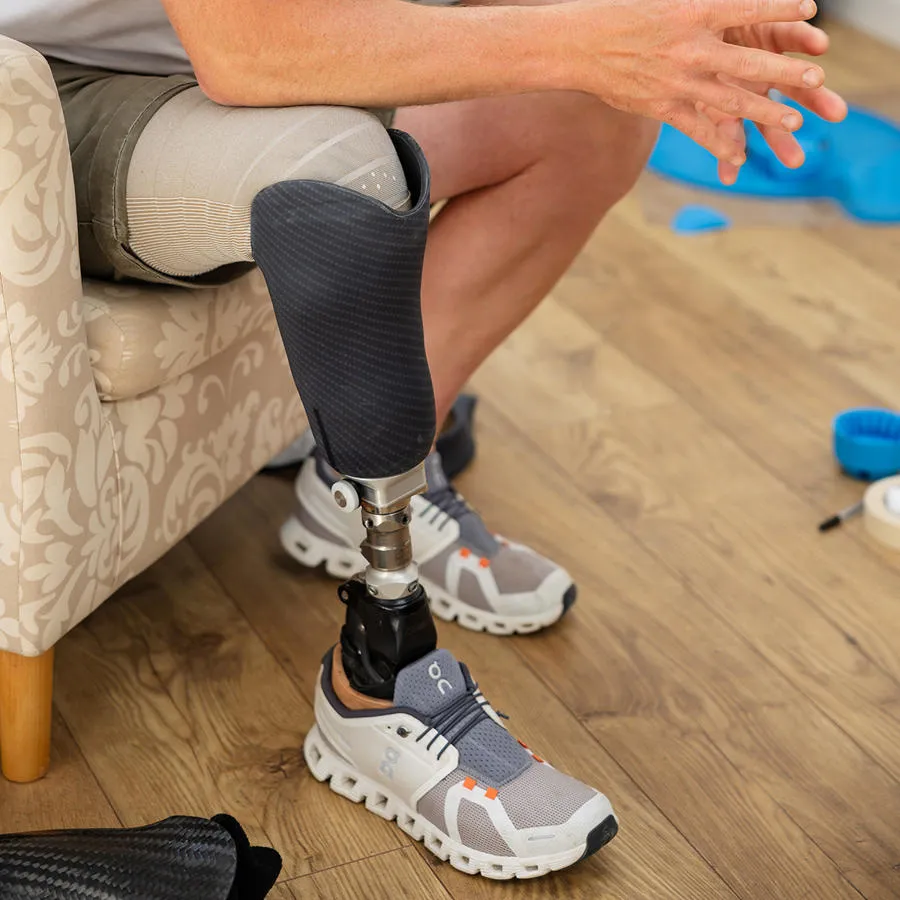
A new generation of prosthetic socket care
Patients undergoing below‑the‑knee amputation can face a challenging recovery. Our goal is to support them by ensuring they receive the best‑fitting socket for their prosthesis, giving them the fastest route to rehabilitation and long‑term successful wear.
Images courtesy of Amparo
The Challenge
People who undergo a below‑the‑knee amputation are typically fitted with a prosthetic limb to support their mobility and independence. The interface between the residual limb and the prosthesis – known as the socket – is crucial for comfort, stability, and successful rehabilitation.

There are approximately 7500 lower limb amputations a year in the UK*
However, during the first year after surgery, the residual limb undergoes significant changes in shape and volume. Traditional polypropylene sockets are custom‑made and cannot easily adapt to these changes. As a result, patients often experience delays to their rehabilitation while waiting for new sockets to be manufactured. Poorly fitting sockets can cause skin problems, such as blisters and wounds, and can be so painful that some patients stop using their prosthesis altogether.
The Approach
A different type of socket, made from a material that can be moulded directly onto the limb and later reshaped through heating, could offer a solution. A remouldable socket has the potential to improve comfort during rehabilitation, reduce waiting times, and help patients begin walking sooner.
This NIHR-funded feasibility study aims to understand the acceptability of this new type of socket to patients and clinicians in the early rehabilitation phase following a below-the-knee amputation.Natalie Vanicek
Professor of Clinical Biomechanics, University of Hull
One such device – the Confidence Socket, developed by project partner Amparo Prosthetics – is already demonstrating these benefits in the real world. It has already been used in humanitarian settings, including during the war in Gaza, where its ability to be made and fitted in a single session, even in challenging surroundings, has enabled patients to receive immediate, effective care.
Working with Amparo and the NHS, we’re leading a significant new study (ASSIST) to investigate whether a remouldable socket can help patients recover more quickly and reduce waiting times following a below‑the‑knee amputation. The study will recruit 80 patients from five NHS prosthetic centres to gather information on:
- socket comfort and patient experience
- time taken to receive a prosthesis and number of clinic visits
- clinician experiences of fitting the remouldable socket.
Patients with lived experience of limb loss have shaped the study from the start, ensuring it reflects real‑world priorities and experiences.
The research team
Professor Natalie Vanicek, University of Hull
Dr Chao Huang, University of Hull
Professor Judith Cohen, Hull Health Trials Unit, University of Hull
Dr Chantel Ostler, Hampshire and Isle of Wight NHS Trust
Professor Maggie Donovan-Hall, University of Southampton
Tim Randell, University Hospitals Dorset NHS Foundations Trust
The Impact
We know that delays in fitting a prosthesis result in delays in recovery. Early indications show that a heat remouldable socket can, not only be fitted quickly, but can also transform early rehabilitation by adapting to the patient as they heal.Natalie Vanicek
Professor of Clinical Biomechanics, University of Hull
An initial pilot study has already shown promising results in a small group of patients, including improved residual-limb skin healing with remouldable sockets.
Many patients still in the early stages of healing face long waits before they can safely use a prosthesis. With a remouldable socket, the prosthetic leg can be delivered on the same day, helping people begin moving sooner and reducing the risk of setbacks caused by prolonged immobility. It can also be remoulded quickly when the patient’s residual limb changes shape or size, which is common in the first 12-18 months.
If the ASSIST study is successful, a full-scale effectiveness trial will be the next step towards making a remouldable socket more readily available to patients.
The long‑term ambition is to understand whether this approach could inform a new standard of care for people undergoing below‑the‑knee amputation, ensuring every patient has the best possible start to their rehabilitation.