Building a scaffold for better healing
Advancing 3D printing technology for custom wound care dressings and devices
Project summary
The Challenge
3D printed scaffolds show promise for wound healing, but evidence is limited. More research was needed to understand how material and design affect performance.
The Approach
Researchers used industrial 3D printing to design anatomically inspired scaffolds, testing materials and structures to balance strength, porosity and healing support.
The Outcome
The study demonstrates the potential of tailored 3D‑printed scaffolds to enhance healing, informing the development of next‑generation regenerative devices for healing.
Institutes and centres

Lead academics
Project funded by


Project Partners



Engineering healing in three dimensions
This research shows how advanced 3D‑printed scaffold design can support soft tissue healing, enabling more effective, customisable wound care solutions informed by material science and clinical need.
The Challenge
Chronic and complex wounds present a significant challenge to healthcare systems worldwide and significantly reduce quality of life for patients. Traditional dressings often protect the wound surface but provide limited structural support for tissue regeneration beneath. Repeated disturbance of the wound during dressing changes can exacerbate trauma and increase infection risk.

Each year the NHS spends between £4.5 - £5.1bn on wound management*
3D printing has enabled the creation of bio-compatible tissue frameworks, or “scaffolds” that help the body heal itself. Additive manufacturing techniques have been used to make custom, patient-specific scaffolds but studies of their efficacy have been limited to relatively simple designs. There was a need to investigate whether 3D printing could support the creation of more complex, anatomically informed scaffold structures, with carefully controlled strength and porosity. And whether these scaffolds could better support tissue regeneration in soft‑tissue and wound‑healing contexts.
The Approach
The aim of this study was to design, fabricate, and evaluate a range of materials and structures for 3D-printed wound scaffolds intended for soft tissue healing. The research team aimed to develop scaffolds that would provide sufficient strength and controlled porosity to support cell infiltration and tissue regeneration.
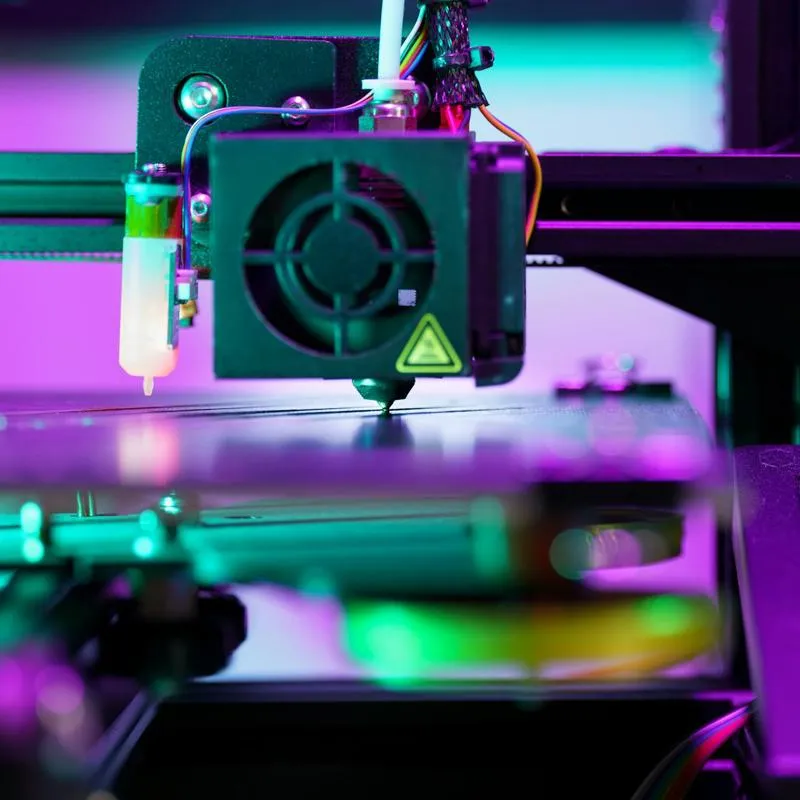
Researchers drew on material extrusion additive manufacturing (MEAM) 3D printing techniques, which are widely used in industry, including in the medical field. The team explored multiple biocompatible polymers. PLA and PCL were chosen as primary structural materials due to their established use in load-bearing biomedical scaffolds, where mechanical strength, controlled degradation, and biocompatibility are essential. PVA and BVOH were included as water-soluble, bioresorbable polymers to investigate their potential roles as temporary or sacrificial materials in meniscus repair strategies.
Using CAD modelling and a custom toolpath generator, eight scaffold designs were developed. These included:
- Square and layered architectures optimised for surface wounds, enabling fluid absorption, permeability and mechanical protection.
- Circular, anatomically inspired designs informed by knee meniscus structure – internal cartilage tissue that is slow to repair from injury – designed to withstand higher mechanical loads.
This approach allowed precise control of pore size, filament orientation and material gradients within the scaffolds.
Prototypes were subjected to mechanical testing, porosity analysis and degradation studies under simulated physiological conditions. This allowed the team to compare how different materials and architectures balanced mechanical strength, permeability and stability, and to assess how scaffold design could be fine-tuned for specific clinical requirements.
Key findings:
- All designs exhibited mechanical properties appropriate for biomedical applications. The square designs with dense edges demonstrated the most favourable balance between mechanical strength, porosity, and mass. These were most suited to skin dressings, rather than internal usage for meniscus injuries.
- Among the knee meniscus designs, there was a trade-off between mechanical strength and permeability. However, the higher porosity designs may be beneficial in applications where enhanced fluid transport and cell infiltration are required.
- The in vitro degradation study demonstrated that PLA exhibited the greatest material stability, indicating minimal degradation under the tested conditions.
- Among the water-soluble materials, PVA showed improved performance relative to BVOH, as it was capable of absorbing a greater volume of exudate fluid and remained structurally intact for a longer duration.
- Tensile testing of PLA scaffolds further revealed that designs with increased porosity towards the centre exhibited superior mechanical performance.
- The strongest scaffold design demonstrated a favourable balance between mechanical strength and porosity that mimics key properties of engineered tissues such as the meniscus.
The research team
Frances E. Longbottom, University of Hull
Dr Amirpasha Moetazedian, University of Hull
Dr Martin Taylor, University of Hull
Research partners:
Dr Heba Ghazal, Kingston University London
Jie Han, Brunel University of London
Aidan Pereira, Brunel University of London
Dr Bin Zhang, Brunel University of London
The Impact
By combining our expertise in 3D printing and engineering of specialist biorenewable materials, we established a system for creating stable, high-performance scaffolds with a new level of personalisation to a specific patient’s needsDr Amirpasha Moetazedian
Lecturer in Medical Engineering, University of Hull
The research findings highlight the potential of 3D-printed, patient-specific scaffolds to enhance wound healing. They also offer a promising approach for next-generation, customised regenerative applications, such as meniscus repair.
The study demonstrated that scaffold architecture can be used to fine tune the balance between strength and porosity, key requirements for effective tissue regeneration.
Features may be incorporated into functional skin repair dressing applications that allow healthcare professionals to visually inspect and clean the wound while enabling excess fluids produced during the inflammatory phase of healing to be absorbed through the scaffold structure. This has potential to help protect wounds from the mechanical damage that would usually occur during handling or dressing changes.
By repurposing established 3D‑printing techniques in innovative ways, the research opens up new possibilities for designing patient‑specific scaffolds tailored to different injuries and healing environments. This approach supports the development of next‑generation medical devices that are customisable, evidence‑based and aligned with real clinical needs.
Publications
Pereira, A., Moetazedian, A., Taylor, M. J., Longbottom, F. E., Ghazal, H., Han, J., & Zhang, B. (2026)
Journal of Manufacturing and Materials Processing, 10(1), 39.
CONVEX (CONtinuously Varied EXtrusion): A new scale of design for additive manufacturing
Amirpasha Moetazedian, Anthony Setiadi Budisuharto, Vadim V. Silberschmidt, Andrew Gleadall (2021)
Elsevier Additive Manufacturing, Vol 37, 101576