

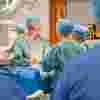

Operating department practitioners (ODPs) are vital members of the surgical team who care for patients before, during and after surgery.
With this degree approved by the Health and Care Professions Council (HCPC), you’ll split your time between learning in our award-winning new Allam Medical Building and on clinical placements.
This means you’ll graduate with the skills, experience and confidence to start your career as an Allied Healthcare Professional and you’ll be able to apply for registration as an Operating Department Practitioner.

100% of students
in work or further study 18 months after graduating
HESA Graduate Outcomes, 2026

7th in the UK
for Teaching Quality
The Times Good University Guide, 2027
3rd in the UK
for Satisfied with Feedback
The Guardian University Rankings 2027
This course is accredited by


Receive £5k a year
or more through the NHS Learning Support Fund1

50/50 split
between classes and placements

Register as an ODP
when you graduate

Specialist training area
in our Critical Care Room

Course designed alongside
local NHS trusts

Operating Theatre
to develop skills and confidence in a surgical setting
About this course
Operating Department Practitioners (ODPs) work as part of a multidisciplinary team in a variety of surgical theatre specialties.
At Hull, you’ll be taught by experts in the field and develop high-quality skills in anaesthetic, surgical and post-operative/anaesthetic care.
Our simulated clinical practice teaching takes place in the cutting-edge facilities of our award-winning new Allam Medical Building on this programme and our course boasts an incredible employability rating – so the career prospects couldn’t be better.
In fact, our degree has been designed in collaboration with local NHS trusts and private healthcare providers to meet the growing demand for ODPs both locally and nationally.
Plus, students studying this course may also receive a payment of at least £5,000 a year. This doesn't need to be paid back and is in addition to any financial support received through your student loan1.
Discover more about health placements - learn why they matter, explore potential destinations, and hear first-hand feedback from fellow health students.
Don’t have the qualifications you need for this course? Our part-time, flexible University Certificate in Health and Social Care Practice has no formal entry requirements - and can open the door to a career as a nurse, midwife, operating department practitioner, paramedic, or social worker.
Learn by getting your hands dirty and clean.
Module options
Each year, you’ll study modules worth a certain number of credits, and you need 120 credits per year. Most modules are 20 credits – so you’ll study six modules each year. Some longer modules, such as a dissertation, are worth more. In these cases, you’ll study fewer modules - but the number of credits will always add up to 120. Some modules are compulsory, some are optional, so you can build a course that’s right for you.
No filters selected
Introduction to Evidence-Based Practice
You'll be discussing research, reviews and guidelines, learning how to assess each to best influence your care for patients.
compulsory
20 credits
Anatomy and Physiology
Develop your knowledge of human anatomy and physiology, exploring homeostasis whilst evolving your understanding of key systems, their interactions and interdependence.
compulsory
20 credits
Clinical Practice Education
You will learn the basic skills of operating department practice in terms of clinical practice and self-development.
compulsory
20 credits
Selfcare in Healthcare
Develop the knowledge and strategies to look after your mental health and manage the psychological demands of acute healthcare practice. You’ll explore self-care, resilience and mental health literacy and how they support your professional practice.
Examine the causes and signs of stress, burnout and fatigue, alongside practical strategies for emotional regulation, work-life balance and managing shift work. You’ll also explore mental health first aid, peer support, reflective practice and how to respond to the emotional impact of critical incidents.
You’ll examine workplace culture, stigma and the importance of accessing support services, including how personal wellbeing contributes to professional practice and patient safety.
compulsory
20 credits
Safety and Risk Management
You will develop an understanding of patient safety, risk assessment and strategies to mitigate errors within the perioperative environment.
compulsory
20 credits
Introduction to Perioperative Practice
You will explore fundamental principles of perioperative care, preparing you with essential knowledge and skills to support patient safety, teamwork and decision-making in the perioperative environment.
compulsory
20 credits
Pathophysiology
You'll examine the pathophysiology of shock, heart failure, myocardial infarction and respiratory failure.
core
20 credits
Research Methods
You will develop the critical thinking skills needed to access and apply research findings to your clinical decision-making process.
core
20 credits
Interprofessional Working
This hands-on module allows you to experience and navigate the complexities of interprofessional collaboration in controlled environments, preparing you for the challenges of actual emergency situations. You'll understand the importance of holistic, patient-centred care and be equipped with essential skills for effective communication and collaboration with professionals from diverse healthcare backgrounds.
core
40 credits

How do you give the best care? Look after yourself.
 Featured module
- compulsory
- 20 credits
Develop the knowledge and strategies to look after your mental health and manage the psychological demands of acute healthcare practice. You’ll explore self-care, resilience and mental health literacy and how they support your professional practice.
Examine the causes and signs of stress, burnout and fatigue, alongside practical strategies for emotional regulation, work-life balance and managing shift work. You’ll also explore mental health first aid, peer support, reflective practice and how to respond to the emotional impact of critical incidents.
You’ll examine workplace culture, stigma and the importance of accessing support services, including how personal wellbeing contributes to professional practice and patient safety.
Our facilities
Watchlist
Degrees that live up to life
Course montage
1 min
BSc Operating Department Practice
Course overview
2 mins
Olayemi Elizabeth Ajayi - Operating Department Practice - Student Stories
Student Story
4 mins
Our healthcare family
Course Highlight
4 mins
Featured academics
Our staff combine teaching and clinical practice with the opportunity to be involved in high-quality research projects.
Their expertise sees them consult with regulatory bodies and government to drive improvement in healthcare and their research is recognised internationally for its quality.

Rebecca Daly
Lecturer
Rebecca is an Operating Department Practitioner who joined the University of Hull in 2013. She is currently the programme admissions tutor and teaches across all levels of undergraduate study as well as on the level 7 Advanced Practice programme.

Natalie Teal
Lecturer
Natalie is an experienced operating department practitioner, clinical practice educator and surgical first assistant. She joined the University of Hull in 2015 and is now Programme Director for Operating Department Practice.
Entry Requirements
How to apply for this course
At Hull, you're a name, not a number. It's not just about the grades - we'll look at your whole application.
If you're not eligible for direct entry to this course, we may recommend a foundation year as an alternative route to studying for a degree.
To discuss your options, send us an enquiry or call us from 8am on Results Day on 01482 466100.
Every year, hundreds of students join the University of Hull through Clearing for all sorts of reasons and go on to achieve great things. Learn more about Clearing.
Qualification types
We accept a wide range of qualifications and combinations of qualifications, including A levels, BTECs and other accepted qualifications.
We don’t just see what you’re like on paper, we see you. All of you. Your achievements, work experience, music and sport qualifications and the projects you’ve been involved in. We want to hear it all.
Fees & Funding
How much is it?

Future prospects
Our degree has an incredible graduate employability rating so the career prospects couldn’t be better.
You’ll graduate with the skills and experience to be a professional healthcare practitioner and eligible to register with the Health and Care Professions Council (HCPC).
Most of our graduates will go on to work in the NHS – but others find positions overseas, in private practice and the Armed Forces. Future progress options could include roles in medical associate professions such as surgical care practitioners and anaesthesia associate.
Learn more about BSc Operating Department Practice
Become part of the next generation of futuremakers
Like what you've seen? Then it's time to apply.
The standard way is to apply through UCAS. This will give you the chance to showcase your skills qualities and passion for the subject, as well as providing us with your academic qualifications.
Not ready to apply yet?
Visit our next Open Day, and see all that the University of Hull has to offer. Talk to our lecturers about your subject, find out what university is really like from our current students, and take a tour of our beautiful campus and amazing facilities.
You may also be interested in...
BSc (Hons) Adult Nursing
Undergraduate
Learn the necessary skills to deliver high-quality healthcare by applying for our research-led, patient-centred BSc Adult Nursing degree course.
B740
BSc (Hons) Midwifery
Undergraduate
Gain the skills and self-confidence to become a qualified midwife and provide a safe and competent experience for the childbearing woman and her baby.
B720
BSc (Hons) Child Nursing
Undergraduate
Our dedicated children's nursing team support students through this course which is divided equally between class-based activities and clinical placements.
B730
BSc (Hons) Learning Disability Nursing
Undergraduate
Help people with learning difficulties in their daily life with our BSc Learning Disability Nursing degree. Apply to start making a difference today.
B761
BSc (Hons) Mental Health Nursing
Undergraduate
Gain the necessary skills and knowledge to deliver high-quality mental health care by applying for our patient-focused BSc Mental Health Nursing degree.
B760
Available to all undergraduate students studying Nursing, Midwifery, ODP, Paramedic Science or Physiotherapy. You don't need to pay this back, and you'll get it as well as your student loan.
All modules presented on this course page are subject to availability and this list may change at any time.