

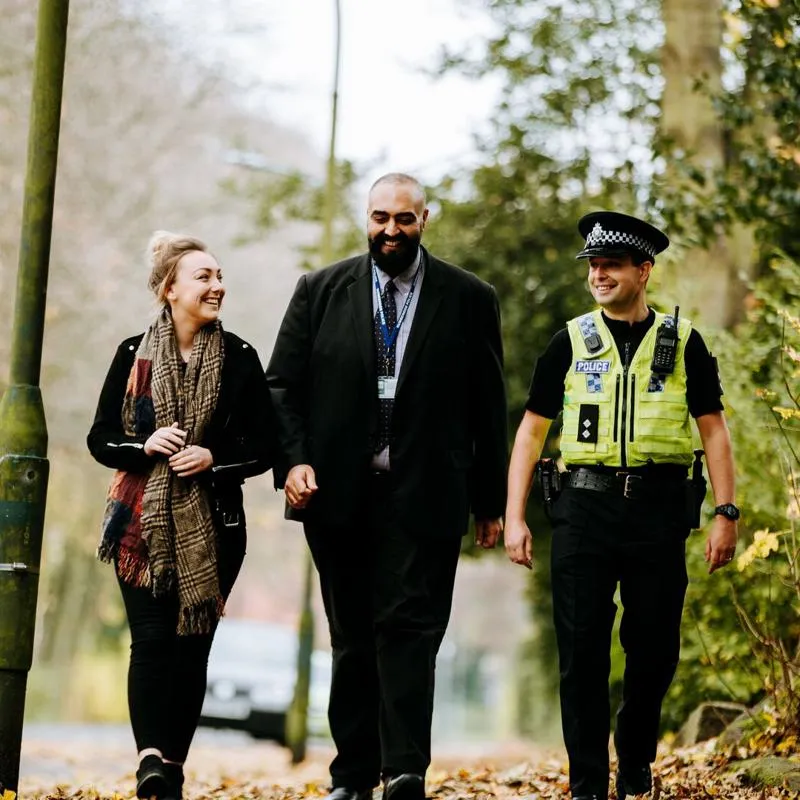

This hands-on policing degree degree will give you the knowledge and skills to become a police officer.
Get into policing with a nationally recognised entry route. Combined with the Government’s commitment to raise the number of police officers, this means you'll have excellent employment opportunities after graduation.
We work closely with Humberside Police to ensure that you’ll have the opportunity to apply to become a Special Constable or Police Service Volunteer.1 So you can gain first-hand experience of policing while studying and be ready to start your career after graduating.
This course is accredited by

About this course
This accredited programme will give you the knowledge and professional skills you need for a career in the police service.
We have an excellent reputation in this field and strong links with local, regional and national criminal justice agencies. Which gives you invaluable experiences including stimulating evidence-based policing project opportunities.
You’ll also learn directly from experienced practitioners through regular guest lectures and specialist sessions. Recent speakers have included officers from Humberside Fire & Rescue, and police officers from rural and wildlife crime and cybercrime units. Topics such as professional standards, digital forensics and contemporary investigative practice ensure your learning reflects the realities and challenges of modern policing.
Explore criminal activity and gain hands-on experience in our replica crime scene facility. You’ll see the process brought to life, with detailed and realistic crime scenes for you to examine and analyse.
You’ll get a taste of life as a police officer alongside your degree with the opportunity to train as a Special Constable or Police Service Volunteer.1 Your employability will be further enhanced as you will complete your degree in line with Humberside Police's Special Constable programme. And you’ll have the chance to network with significant regional and national employers at our annual Crime and Social Justice careers event.
Partners in crime prevention
Module options
Each year, you’ll study modules worth a certain number of credits, and you need 120 credits per year. Most modules are 20 credits – so you’ll study six modules each year. Some longer modules, such as a dissertation, are worth more. In these cases, you’ll study fewer modules - but the number of credits will always add up to 120. Some modules are compulsory, some are optional, so you can build a course that’s right for you.

Filters
Understanding and Preventing Crime
You will be introduced to key concepts, theoretical approaches and their application, in relation to crime, victimisation and response to crime and deviance.
compulsory
20 credits
Research methods in Policing
Using extensive ‘real world’ case studies and datasets, this module will provide students with an understanding of those research strategies and methods most relevant to undertaking research within the fields of policing, criminal justice, crime prevention and community safety and harm reduction.
compulsory
20 credits
Investigating Neighbourhood Policing
This module provides insight into the meaning, purpose, development and implementation of community policing.
compulsory
20 credits
Victims, Offenders and the CJS
You will gain an understanding of the roles and functions of the different agencies working within the British criminal justice system and introduces students to the principles of evaluative research, with special emphasis on evaluation of criminal justice and crime prevention initiatives.
compulsory
20 credits
Understanding the Police Role
You will develop an understanding of the social, political and historical development of policing, placing British policing within its local, regional and national context.
compulsory
20 credits
Valuing Difference and Inclusion
Covering equality, diversity and human rights considerations as a core function of professional practice, you will examine the relationship between workforce representativeness, equal opportunity and non-discrimination, police legitimacy and effective service provision.
compulsory
20 credits
Decision Making and Discretion
This introduces you to theoretical explanations of decision making, the role of discretion and bias in decision-making, and provides an understanding of the rationale underpinning the development and application of the National Decision Making Model (NDM), and how it is applied to policing practice.
compulsory
20 credits
Police Investigations
This introduces students to the key aspects of the criminal investigation process.
compulsory
20 credits
Policing the Police
In this, you will cover police professional standard issues and the application of ethical and professional standards within policing practice and governance.
compulsory
20 credits
Our facilities

Watchlist
Mike McKue
Course overview
1 min
Life on campus
University life
2 mins
Teaching Facilities
University life
2 mins
Featured academics
Our academics are accredited College of Policing practitioners and former police officers with extensive experience in investigation, response, and front-line policing. They teach across areas including neighbourhood policing, public protection, digital innovation, counter-terrorism, and the wider role of the police.
Alongside their professional expertise, our team bring a range of research specialisms - with examples including the history of policing, women in policing, and broader criminology.

Mike McKue
Lecturer - Programme director
Mike has over 20 years of frontline policing, Mike is the Programme director for the course, his research is focused on Trust and Confidence in modern day policing and delivers modules across the programme at all levels on police specific topics.

Gill Hodgson
Lecturer
After graduating with a Law degree in 1996, Gill served for 12 years as a Police Constable and Detective Constable in Hertfordshire and Lincolnshire, specialising in front-line policing and CID.
Entry Requirements
What do I need?
When it comes to applying to university, you'll need a certain number of UCAS points. Different qualifications and grades are worth a different amount of points. For this course, you'll need 112 UCAS points.
At least 80 points must come from A levels, BTEC, or other equivalent qualifications.
We consider experience and qualifications from the UK and worldwide which may not exactly match the combinations above.
But it's not just about the grades - we'll look at your whole application. We want to know what makes you tick, and about your previous experience, so make sure that you complete your personal statement.
Typical offer
112 UCAS points
A levels
BBC
BTEC
DMM
Fees & Funding
How much is it?
Tuition fees for 2027 entry have not been confirmed. Please use 2026-27 information as a guide.
For UK students, our standard course fee is £9,790 per year. Keep in mind that some courses are longer - for example, spending your third year abroad will make your degree four years in total.
If you choose to study a foundation year as part of your course, the fee is £5,760.
How do I pay for it?
You can take out a tuition fee loan to cover the full cost of your course. Once you’ve successfully applied for this, you don’t need to do anything else – the money is sent straight to us.
You can also take out a maintenance loan of up to £10,544 a year to cover your living costs, depending on your household income.
Remember, you won’t start paying your loans back until you’ve left university and earn more than £25,000 per year.
See our full fees and funding information for more details and to find out what support we can offer.
Standard Tuition Fee
£9,790 / year
The amount you pay may increase each year, in line with inflation - but capped to the Retail Price Index.

Future prospects
While this degree prepares you for a career in policing, it will also open up wider opportunities within the criminal justice arena.
Our partnership with Humberside Police gives you the practical skills and experience to progress into policing and wider criminal justice roles. Graduates have gone on to join local and national police forces, specialist constabularies, Ministry of Defence police, the prison and probation services, counter‑terrorism teams and organisations such as the CPS, as well as roles in intelligence, investigations and teaching.
Other career opportunities lie within data analysis, social justice, victim support, voluntary work, criminology and law-related careers, as well as many areas of research.
Although this degree is recognised by the police service, it does not guarantee recruitment as a police constable, so applicants should check eligibility requirements for both Police Constable roles and the Special Constabulary.
Learn more about BSc Professional Policing
Become part of the next generation of futuremakers
Like what you've seen? Then it's time to apply.
The standard way is to apply through UCAS. This will give you the chance to showcase your skills qualities and passion for the subject, as well as providing us with your academic qualifications.
Not ready to apply yet?
Visit our next Open Day, and see all that the University of Hull has to offer. Talk to our lecturers about your subject, find out what university is really like from our current students, and take a tour of our beautiful campus and amazing facilities.
You may also be interested in...
Applications for the Special Constable training programme are made directly through Humberside Police. We will support during the application process.
94% employability (Criminology) UK domicile full-time first degree leavers; Higher Education Graduate Outcomes statistics, for the academic year 2022/23, published by the Higher Education Statistics Agency June 2025.
All modules on this course page are subject to availability and this list may change at any time.