

The world needs people like you. An environmental scientist in the making, who can understand and manage the issues shaping our planet.
Join a University that cares deeply about a sustainable future for all. Our IES-accredited course3 will give you a range of practical, field and analytical skills to help you solve real environmental problems.
You can take part in field trips across the UK and overseas, choose to spend a year studying abroad or on placement, and even learn to scuba dive as part of your degree.
Designed with your future career in mind, the course offers opportunities to gain real-world experience, build professional networks and develop the skills employers are looking for. You'll also benefit from dedicated careers support to help you prepare for your future.

100% of students
in work or further study 18 months after graduating
HESA Graduate Outcomes, 2026

Joint 5th in the UK
for Value Added
The Guardian University Rankings, 2027
This course is accredited by


Field trips
in the UK and overseas1

Dive in
and train to become a PADI-certified diver 2

Boost your CV
with a placement year

Integrated Masters option
Undergraduate and postgraduate study combined

Personal supervisor
and small study groups
About this course
From climate change and biodiversity loss to pollution and resource management, the decisions we make today will shape the future of our planet. On this degree, you'll explore the complex forces shaping our planet. You'll gain a thorough theoretical and practical grounding in the elaborate nature of environmental systems and our relationship with them. And you'll study in a region at the forefront of environmental change, from coastal erosion and flood risk to renewable energy and nature recovery.
You'll learn by doing. Analyse samples in the lab. Develop specialist skills in Geographical Information Systems (GIS). Take part in fieldwork in the UK and overseas, to destinations such as Brazil, Egypt and Mallorca1. Alongside hands-on experience, you'll learn from experts in biology, geography and earth science.
As your interests develop, you can tailor your studies through optional modules covering ecological, chemical and physical aspects of the environment. You'll also complete an independent research project on a topic that matters to you.
Want to go deeper? Your can even learn to dive2 alongside your degree, developing specialist skills such as underwater navigation and photography.
Tackle some of the planet's greatest challenges
Year abroad
Study Abroad programmes take place over a full academic year. This extends a standard undergraduate degree from three to four years, with study abroad taking place in year three. Once you've completed your study abroad year, you'll return to complete the final year of your degree at the University of Hull.
There are many reasons to undertake a study abroad year. For one, you’ll make unforgettable memories with a whole range of countries to choose from. But more than that, you’ll boost your confidence and your contacts. And you’ll gain skills that will make employers take notice of you: curiosity, sociability, adaptability, and intercultural awareness.
Module options
Each year, you’ll study modules worth a certain number of credits, and you need 120 credits per year. Most modules are 20 credits – so you’ll study six modules each year. Some longer modules, such as a dissertation, are worth more. In these cases, you’ll study fewer modules - but the number of credits will always add up to 120. Some modules are compulsory, some are optional, so you can build a course that’s right for you.
No filters selected
Planet Earth
Develop an understanding of the Earth as a planet – the atmosphere and oceans working together to create global patterns of climate and ocean circulation; plate tectonics and the movement of continents; living systems evolving over time and forming the global biosphere; and the surface processes of accumulation and erosion shaping the landscapes around us. The module will help you to see how ideas in physical geography can be used to understand patterns observed in the natural environment at a global and continental scale.
compulsory
20 credits
Exploring Worlds Around Us
You’ll find out about many different ways of studying the world around us by exploring a specific field trip location.
compulsory
20 credits
Marine Biology: An Introduction
From space, the planet is blue. Marine life has evolved into a myriad of forms living in some of the most extreme habitats on the planet; from great depths to battered coasts. This introduction to marine biology explores the marine environment, the diversity of life within it and how to conserve it.
compulsory
20 credits
Environmental Problems and Solutions
Discover the fundamental principles of environmental systems and the interconnectedness of humankind with the environment.
compulsory
20 credits
Interpreting Environments
This module introduces you to some key tools we use to interpret the environments around us, such as computer mapping and data analysis.
compulsory
20 credits
Analytical Techniques for Biochemical and Environmental Monitoring
This module gives an introduction to analytical chemistry techniques; spectroscopy, chromatography and mass spectrometry. You will develop an understanding of principles and applications of such techniques relevant to real world applications. You will gain an overview of available techniques, key principles and appropriate workflows and appreciation of how to prepare, obtain and carry out data analysis for real samples.
optional
20 credits
Ecology (with optional Dive Training)
Ecology is the study of interactions among living organisms and their environment, and is the basis for nature conservation and understanding human impact on the planet. Gain an understanding of ecological theory, applied ecology, and the collection and analysis of ecological data. You can choose to complete integrated PADI Advanced Open Water training, with an opportunity to develop specialist diving skills relevant to ecological science.
optional
20 credits
Research Design in Geography, Earth and Environment
A key skill for investigating the challenges of the world today is to learn how to ask questions and design a strategy for answering them. This module provides you with a chance to practice that skill in a group project before you design the questions for your dissertation.
You will also start to consider career options for after your degree and you will start to explore what you can do now to help improve your employability.
core
20 credits
Placement Year (HUBS)
Gain valuable experience outside the classroom through a placement opportunity. You’ll have the chance to apply what you’ve learned in a professional environment, develop your skills and gain a broader perspective on your subject and future career.
core
120 credits
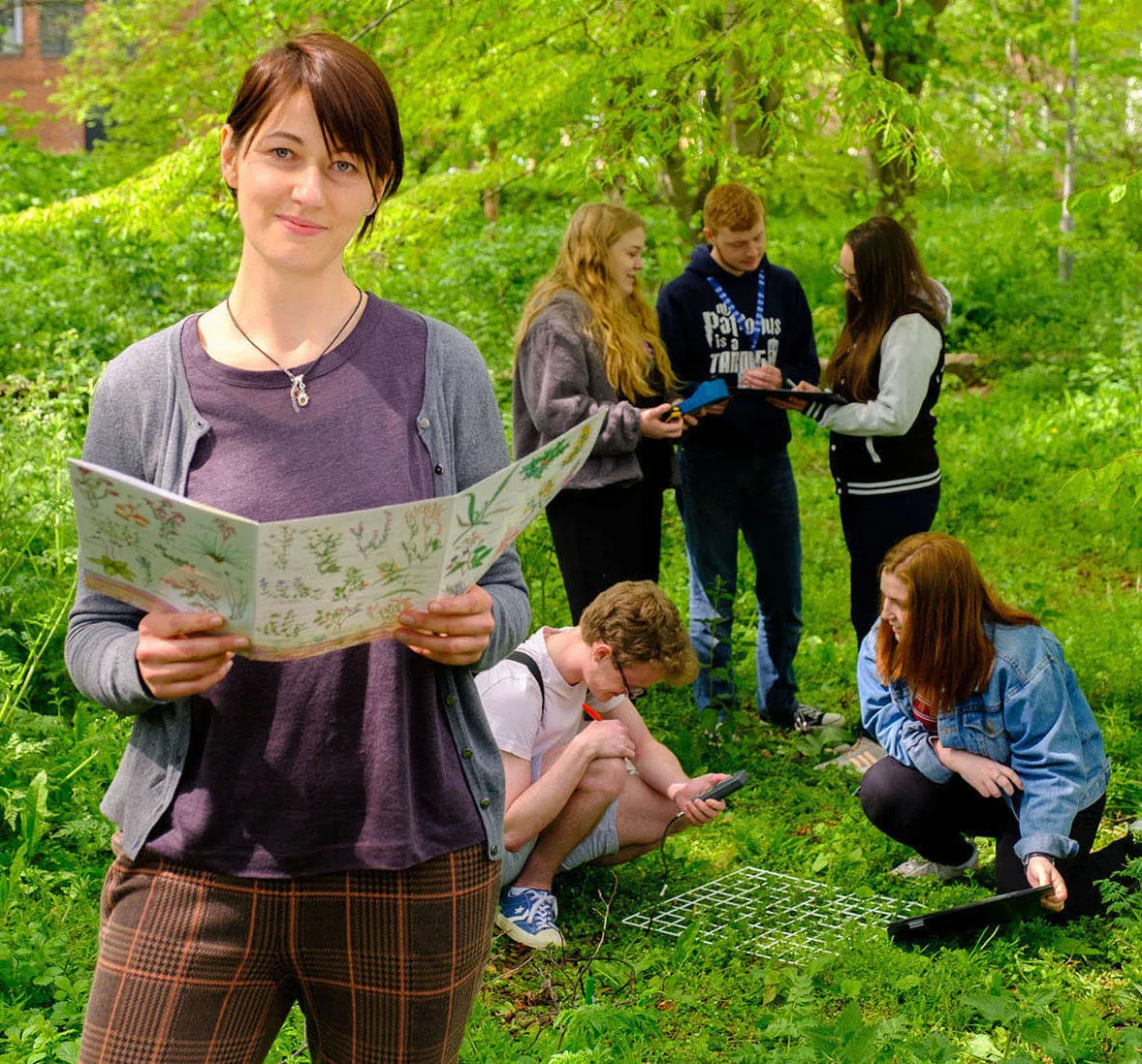
Digging deeper to protect the planet
 Featured module
- compulsory
- 20 credits
Explore the science behind environmental protection and sustainable resource management, and how it can support the shift to a low-carbon future.
You’ll investigate how pollutants move through soil and water, alongside approaches to risk assessment, land remediation and water quality management. Examine green technologies including geothermal energy and carbon capture and storage, as well as the exploration of critical minerals.
Through laboratory sessions, fieldwork and real-world projects, you’ll gain experience in environmental sampling and data analysis. You’ll also develop practical skills in professional reporting used across the environmental sector.
Our facilities
Watchlist
Alex Riley
Course overview
2 mins
Your course in their words
Student Story
1 min
Tenerife field trip 2023
Course Highlight
2 mins
Teaching Facilities
University life
2 mins
Featured academics
Over 80 environmental experts and world-leading scientists make up our Energy and Environment Institute.
People who bring their research, experience and passion into everything they teach. And you’ll get the chance to study with and learn from them.

Dr Alex Riley
Lecturer in Environmental Science
Alex’s research focuses primarily on the use of GIS and field studies to assess the risks posed by legacy waste landfill sites on the coastal environment, and how these risks may change under future climate scenarios.

Professor Will Mayes
Environmental Science
Will’s passionate about field and practical-based teaching to help us manage the environmental issues we currently face. His research investigates how we can better manage the most carbon-intensive and polluting sectors of our economies.
Entry Requirements
What do I need?
This course has a range of tariffs for entry. Use the interactive slider to choose a number of points and see the course entry requirements.

Slide to set your points
A levels
BBC
BTEC
DMM
Equivalent qualifications and grades are accepted.
How to apply for this course
Most importantly, you need ambition. Together with our support and opportunities, you can go further than you ever thought possible.
Our typical offer for this course is 96–112 UCAS points. Our contextual offer is 96 points. But there’s no ceiling on ambition.
At least 80 points must come from A levels, BTEC, or other equivalent qualifications.
Remember, we look at your whole application – not just grades. Achievements, work experience, extracurricular activities: they all count here. We also consider qualifications and experience from the UK and worldwide that may not exactly match those listed.
Not sure if you’ll meet the entry requirements?
Talk to our Admissions team today. We’ll look at your circumstances, give you personalised guidance and help you understand your options, one of which could be a Foundation Year.
Fees & Funding
How much is it?
Tuition fees for 2028 entry have not been confirmed. Please use 2027-28 information as a guide.
For UK students, our standard course fee is £10,050 per year. Keep in mind that some courses are longer - for example, spending your third year abroad will make your degree four years in total.
If you choose to study a foundation year as part of your course, the fee is £10,050.
Thinking about a year in industry? This is £2,010 for UK students.
Planning a year abroad? This costs £1,505 for UK students.
Standard Tuition Fee
£10,050 / year
Year Abroad Fee
£1,505
The amount you pay may increase each year, in line with inflation - but capped to the Retail Price Index.
How do I pay for it?
You can take out a tuition fee loan to cover the full cost of your course. Once you’ve successfully applied for this, you don’t need to do anything else – the money is sent straight to us.
You can also take out a maintenance loan of up to £10,544 a year to cover your living costs, depending on your household income.
Remember, you won’t start paying your loans back until you’ve left university and earn more than £25,000 per year.
See our full fees and funding information for more details and to find out what support we can offer.
Future prospects
The industry is calling out for graduate geologists like you. With a 100% employability rate, once you graduate, you’ll be qualified to pursue geological careers in environmental consulting, remediation, renewable energies, exploration geology, surveying and engineering, with employers including the likes of the Environment Agency, environment consultancies, local councils or wildlife trusts.
Or you can put the transferable practical, research and numerical skills you’ll develop to good use in a wholly different way: teaching, finance, data analysis, and more.
The programme is also an ideal platform for further study.
Become part of the next generation of futuremakers
Like what you’ve seen? Then it’s time to apply.
The standard way to apply is through UCAS. This will give you the chance to showcase your skills, qualities and passion for the subject, as well as providing us with your academic qualifications.
Not ready to apply yet?
Visit our next Open Day, and see all that the University of Hull has to offer. Talk to our lecturers about your subject, find out what university is really like from our current students, and take a tour of our beautiful campus and amazing facilities.
You may also be interested in...
BSc (Hons) Geography
Undergraduate
Uncover the dynamic processes allied with human & physical geography with our BSc Geography degree. Apply today to begin developing your new skills.
F800
BSc (Hons) Earth and Environmental Science
Undergraduate
From climate change to clean water, geohazards to green energy: sustainability is at the core of our BSc Earth & Environmental Science degree.
F640
BSc (Hons) Marine Biology
Undergraduate
The North Sea + The Deep + scuba dive training + field trips to locations like Brazil and Egypt + world-leading researchers = the perfect place to study.
C160
BSc (Hons) Zoology
Undergraduate
Explore all aspects of animal life, from a subcellular level to entire ecosystems. Then focus on a specialist area that could become your career.
C300
Most overseas field trips run in the summer between the second and third year. There is an extra charge, but the trips are subsidised. Destinations listed above are currently included in our list of field trip opportunities, but may be subject to change.
Choose subsidised dive training as part of our Ecology module and become a PADI-certified Advanced Open Water Diver. Extra fee may be payable.
BSc Environmental Science is accredited by the Committee of Heads of Environmental Sciences (CHES), which is the education committee of the Institution of Environmental Sciences (IES). CHES is the collective voice of the environmental sciences academic community. It serves to enhance the quality of environmental education worldwide.
All modules on this course page are subject to availability and this list may change at any time. All field trips on this course page are indicative and locations may change at any time.