From years... to days
Revolutionising endometriosis diagnosis and treatment
Project summary
The Challenge
Women currently wait over nine years for an endometriosis diagnosis. Delays in care leave millions in pain and highlight the need for faster, non-invasive tests.
The Approach
We’re developing a non-invasive test using urine biomarkers to detect and classify endometriosis, undertaking trials to enable a clinical roll-out.
The Outcome
EndoTect could cut diagnosis from years to days, helping patients to receive appropriate care sooner and reducing the need for invasive surgeries.
Lead academics
Project funded by

Project Partners
University of Hull
Hull York Medical School
HEY Endometriosis Support Group
Hull University Teaching Hospitals NHS Trust
University of Edinburgh
University of Liverpool
We’re bringing women new hope of earlier treatment and better outcomes
Our pioneering, non-invasive test could reduce endometriosis diagnosis from years to days, helping patients access the right treatment more quickly, while easing pressure on the NHS.
The Challenge
Endometriosis affects 1 in 10 women of reproductive age. It takes an endometriosis patient an average of nine years and four months to receive a diagnosis. On average, patients will visit their GP ten times before they receive a referral for an ultrasound scan or gynaecology appointment. There are currently 750,000 women on a wait list to see a gynaecologist in the UK, of which 600,000 will receive a diagnosis of endometriosis.
While deep endometriosis may be visible on an ultrasound scan, currently, the only way to definitively diagnose endometriosis is through keyhole surgery (a diagnostic laparoscopy).

Endometriosis affects 1.5 million women in the UK and around 175 million worldwide
Endometriosis UKEndometriosis is a painful and debilitating condition, where cells similar to those lining the womb are found outside of the womb, most often in the abdomen on the ovaries, bladder, kidneys, colon, but for 1% of patients they may be found in the lungs or brain. During the menstrual cycle, this endometrial-like tissue responds to hormonal changes by building up and breaking down. With no way for the blood to exit the body, this can cause inflammation and pain, as well as scarring and adhesions. If the disease advances without treatment, patients may suffer damage to internal organs. A late diagnosis increases the likelihood of surgical interventions being required.
The combined annual cost of endometriosis to the UK economy in lost wages and NHS costs is around £8.2bn. The disease also brings an increased risk of infertility and cardiovascular issues. There is an urgent need for a new approach to endometriosis diagnosis that allows patients to be identified and treated quickly and appropriately.
The Approach
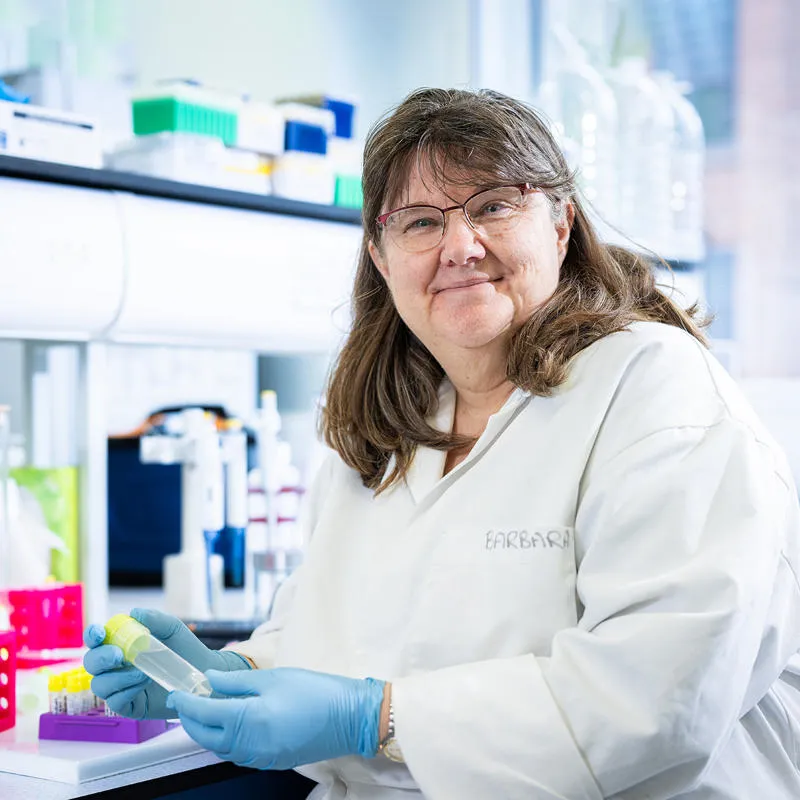
One of the biggest challenges in women’s health is the lack of a non-invasive, diagnostic test that can help us determine if someone has endometriosis and make sure that they get treated with the right medication in the right timeframe.Dr Barbara Guinn
Reader in Biomedical Sciences, University of Hull
Dr Barbara Guinn is addressing the need for a non-invasive test for endometriosis, leading research that could transform how the condition is detected.
The research is based around a simple test, where specific proteins are identified in a urine sample, to indicate whether the patient has deep endometriosis.
Since 2019, Dr Guinn has been running a clinical study with colleagues at the Hull and East Yorkshire Endometriosis Centre at Caste Hill Hospital, which to date has involved nearly 500 women with suspected endometriosis alongside 200 healthy volunteers.
This successful initial study has led to the development of the ‘EndoTect’ prototype test. The research team are now carrying out further tests with samples from patients seen in Liverpool and Edinburgh. This will provide evidence that the test is robust and reproducible in clinical settings and can reliably detect and triage endometriosis patients, as we work towards UK and international regulatory checks and submissions.
The research also combines clinical findings with studies of Office of National Statistics (ONS) datasets to develop best-practice referral guides for GPs. This will help to identify patients earlier and enable GPs to quickly direct them to appropriate care pathways.
The research team
Dr Barbara Guinn, Reader in Biomedical Sciences, University of Hull
Mrs Jane Allen, Director, HEY Endometriosis Centre at Hull University Teaching Hospitals NHS Trust
Mr Keith Cunningham, Deputy Director, HEY Endometriosis Centre at Hull University Teaching Hospitals NHS Trust
Mr Danny Fletcher, PhD student, Hull York Medical School
Dr Snehal Kadam, Knowledge Exchange Officer, Research, Commercialisation & Knowledge Exchange Services
Professor Dharani Hapagama, Professor of Gynaecology and Deputy Head of the Department of Women's & Children's Health, University of Liverpool
Mrs Jane Rice, Research Nurse, HEY Endometriosis Centre at Hull University Teaching Hospitals NHS Trust
Dr Neil Ryan, Chief Scientific Officer Clinical Lecturer and Subspecialty Trainee in Gynaecology Oncology, Institute of Regeneration and Repair, University of Edinburgh
Dr Lucy Wiseman, Postdoctoral Research Fellow, University of Hull
/
The Impact
A faster diagnosis is the first step towards improving outcomes across the board and could transform women’s experiences and put them on a faster pathway to treatment.Dr Barbara Guinn
Reader in Biomedical Sciences, University of Hull
This research has the potential to fundamentally change how endometriosis is diagnosed and managed.
This simple, non-invasive EndoTect test could dramatically reduce the time patients wait to receive a diagnosis of deep endometriosis from years to days, opening up earlier access to best practice treatment. By identifying deep endometriosis without the need for invasive surgery, this test will allow clinicians to rapidly triage patients into the most appropriate care pathway.
Once rolled out, the test has the potential to save time and money for the NHS and patients, and improve patient quality of life.
Dr Guinn’s research is helping to close the gender health gap, bringing faster, fairer and more effective diagnosis within reach for millions of women.
Publications and outputs
Dr Guinn’s research is featured in Endometriosis: 'I thought I was dying' on BBC Ideas.
Wioletta Dolińska, Hannah Draper, Lara Othman, Chloe Thompson, Samantha Girvan, Keith Cunningham, Jane Allen, Alan Rigby, Kevin Phillips, Barbara-ann Guinn
F&S Reviews, Elsevier, Jan 2023
Jeanette M. Rotchell, Chloe Austin, Emma Chapman, Charlotte A. Atherall, Catriona R. Liddle, Timothy S. Dunstan, Ben Blackburn, Andrew Mead, Kate Filart, Ellie Beeby, Keith Cunningham, Jane Allen, Hannah Draper, Barbara-ann Guinn
Ecotoxicology and Environmental Safety, Elsevier, April 2024
Hannah Draper, Lucy Wiseman, Leah Cooksey, Daniel Fletcher, Chao Huang, Sarah Collins, Kevin Phillips, Keith Cunningham, Jane Allen, Barbara-ann Guinn
Pre-print, Authorea, December 2025