 Available in Clearing
Gain the clinical skills to prevent, diagnose and treat musculoskeletal conditions with this hands-on degree.
Designed for students wishing to specialise in a role related to sport and fitness, this fully-accredited course combines theory, hands-on experience, critical reflection and professional judgement, as well as the latest techniques in exercise rehabilitation.
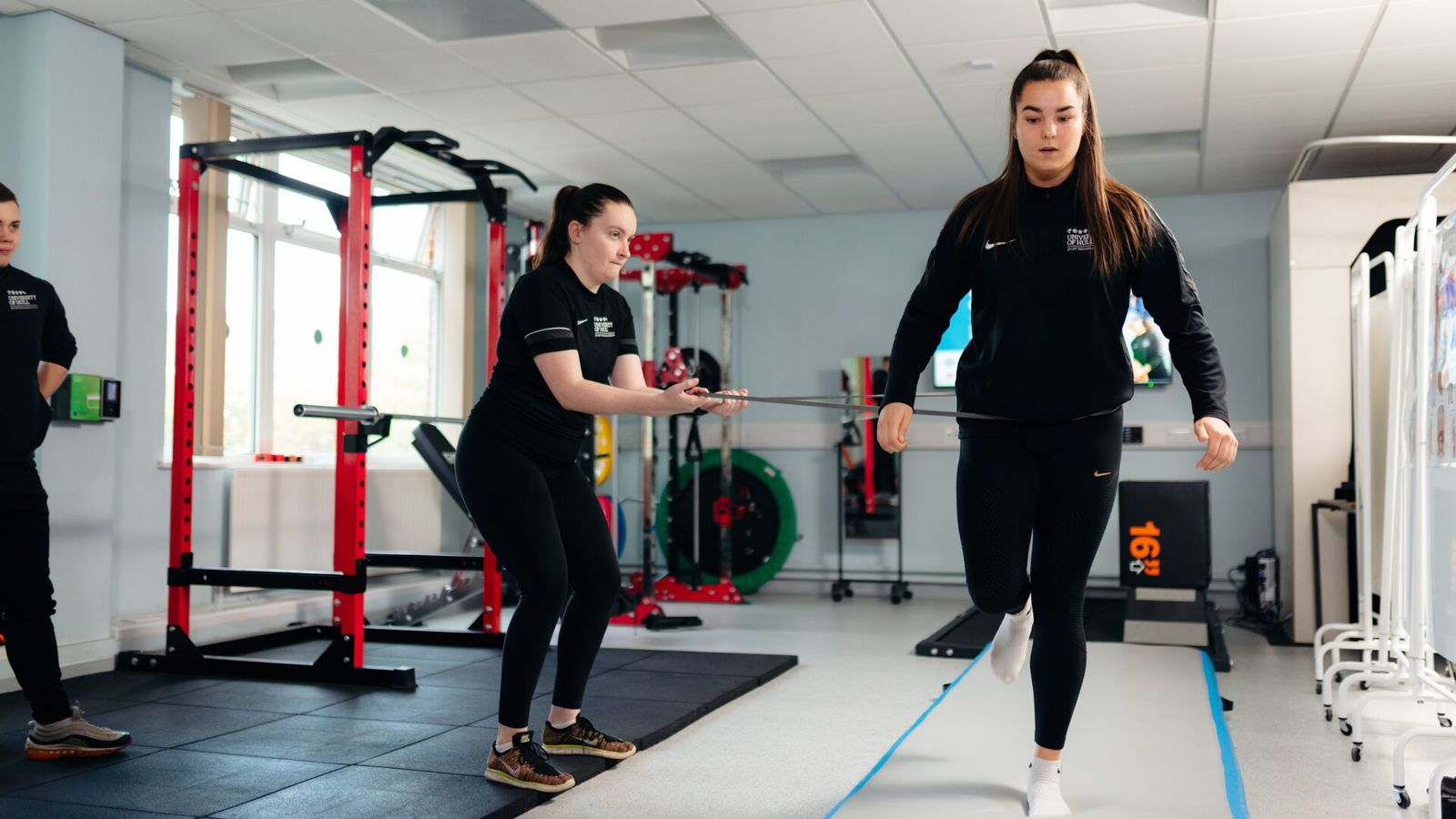
You’ll learn in modern, fully equipped facilities and have access to CV-boosting opportunities to kickstart your career before you graduate. This includes being part of the University's Health, Injury and Performance (HIP) Hub following recent investment, as well as utilising our newly-built strength and conditioning suite.

2nd in the UK
for Satisfied with Feedback
The Guardian University Rankings, 2026
10th in the UK
for Satisfied with Teaching
The Guardian University Rankings, 2026
10th in the UK
for Teaching Quality
The Times Good University Guide, 2026
7th in England
for Assessment and Feedback
Health Sciences, National Student Survey (NSS), 2026, HEIs only
This course is accredited by

£16 million
in new sports facilities, including a state-of-the-art gym and new pitches. So, you'll be learning with the sector's most innovative technologies.

Direct links
to local sports teams, the NHS, and nutritional health providers

Fully accredited course
and 400 placement hours

Career focused
placement opportunities

Latest equipment to learn
the fundamental practical skills of exercise physiology

Two specialist
state-of-the-art sport rehabilitation suites
About this course
Sport Rehabilitators work with patients or athletes with a wide range of neuro-musculoskeletal conditions, whether it’s managing or treating a long-term medical issue or overseeing their recovery from a shorter term injury.
You’ll therefore need to have the confidence to act with independent autonomy towards your patient’s care when necessary, as well as the ability to work with other healthcare professionals, so a thorough grounding in the likes of physiology, psychology, biomechanics, and strength and conditioning is essential.
You’ll also spend a minimum of 400 hours on clinical placement gaining real-world experience, with our partners including professional sports clubs such as Hull FC and Hull KR, as well as private practitioners.
You could even develop your experience at the University's Health, Injury and Performance (HIP) Hub. This student-led clinic offers appointments to real patients from the local community and gives you the opportunity to put your knowledge into practice by overseeing their assessment, diagnosis, treatment and rehabilitation as part of your degree.
You’ll have the chance to showcase your final-year project at our Student Thesis Conference, celebrating your research alongside fellow students and professionals. It’s a fantastic way to develop presentation skills, make even more industry connections, and share your passion for sport and exercise science - learn more here.
This degree is accredited by the British Association of Sport Rehabilitators and Trainers (BASRaT). This means you can apply to BASRaT to become a graduate member at the end of your degree.
Study speed, stamina and agility at your own pace
Foundation year
A foundation year at the University of Hull gives you a solid grounding of knowledge and boosts your academic skills, so you can progress on to your chosen programme with confidence.
The foundation course you enrol on may not be an exact match to your chosen degree, but don’t worry. Our foundation courses combine content from multiple related courses in the same subject area, giving you more flexibility and choice about the degree path you take.
For example, if you apply for a Music Foundation Year, you’ll join our Media Foundation course. So, if you decide to switch - say, from Music to Graphic Design - you can do so without restarting your foundation year.
Module options
Each year, you’ll study modules worth a certain number of credits, and you need 120 credits per year. Most modules are 20 credits – so you’ll study six modules each year. Some longer modules, such as a dissertation, are worth more. In these cases, you’ll study fewer modules - but the number of credits will always add up to 120. Some modules are compulsory, some are optional, so you can build a course that’s right for you. To graduate, you will be required to complete Emergency First Aid and Level 2 RFU Pre-Hospital Immediate Care in Sport.
No filters selected
Preparing for Learning in Higher Education
This module is designed to give you the best possible start to your university studies, making sure you have all the essential skills you need to succeed. Through lectures and workshops we will teach you how to write in an academic style, how to find quality sources, and how to reference work, culminating in writing up a mini-research project.
core
20 credits
Group Challenge
In a group, you'll formulate questions that can be tested by scientific investigations and take part in weekly workshops with academics.
core
20 credits
Foundation in Data Analysis
Develop a strong foundation in data collection and analysis. This module will introduce you to qualitative and quantitative data and how to analyse it; the collection of primary and secondary data; the production of high-quality graphics; and report writing.
core
20 credits
Introduction to Biological Sciences 1
This module will provide you with the basic biological science knowledge that will enable you to transition successfully into the certificate stage of your chosen programme of studies. You will gain basic knowledge of cell biology, biological molecules, energy processes like respiration, neurobiology and many other topics. Alongside the theoretical knowledge, you will also have the opportunity to learn how to use a microscope and how to collect data in the laboratory, in a specialist sport science facility or using psychological techniques. You will also learn how to present and write about those data professionally. The teaching team for this module consists of lecturers in the disciplines connected to your programmes of study, so there will be a strong connection to your chosen subject area.
compulsory
20 credits
Introduction to Sport, Health and Exercise Science
Module information coming soon.
compulsory
20 credits
Foundation Maths Skills
This module delivers core mathematics skills at level two and three to give a solid basis for future studies. You will study the following topics: manipulation of numerical data and converting between different units of measurement; exponentials and logarithms; and standard form and problems involving ratio, proportion and percentages.
optional
20 credits
Foundation Mathematics 1
This module delivers core mathematics skills to build a solid basis for future studies. You will study the following topics: factors, multiples, indices, fractions and standard form; algebra, linear and quadratic equations; averages and spread; functions, exponentials and logarithms; and right-angled triangles and trigonometry.
optional
20 credits
Foundation Mathematics A
You will study pure mathematics topics, including proof, algebra, trigonometry, differentiation, integration, exponentials, logarithms, sequences and series. The applied topic is probability and statistics.
optional
20 credits
Human Anatomy
This module introduces you to the human anatomy in detail. You’ll explore topics including: the structure of the human skeleton, major landmarks, and joints and classification.
core
20 credits
Our facilities
Watchlist
Degrees that live up to life
Course montage
1 min
Dr Ben Oliver
Course overview
2 mins
Andy Ayre
Student Story
2 mins
Facilities
Course Highlight
3 mins
Strength and Conditioning Course Overview
Course overview
2 mins
Featured academics
You’ll be taught by experts who know your name: tutors who work at elite, semi-elite and amateur levels of sport and in private practice.
Our highly-qualified staff also deliver trauma courses for the Rugby Football Union nationally.

Lois Smith
Director of Studies
Lois is our Director of Studies in Sport, Exercise and Rehabilitation Science. After initially joining the University in 2017, she completed her Masters the following year and has gone on to become a Senior Fellow of the Higher Education Academy.
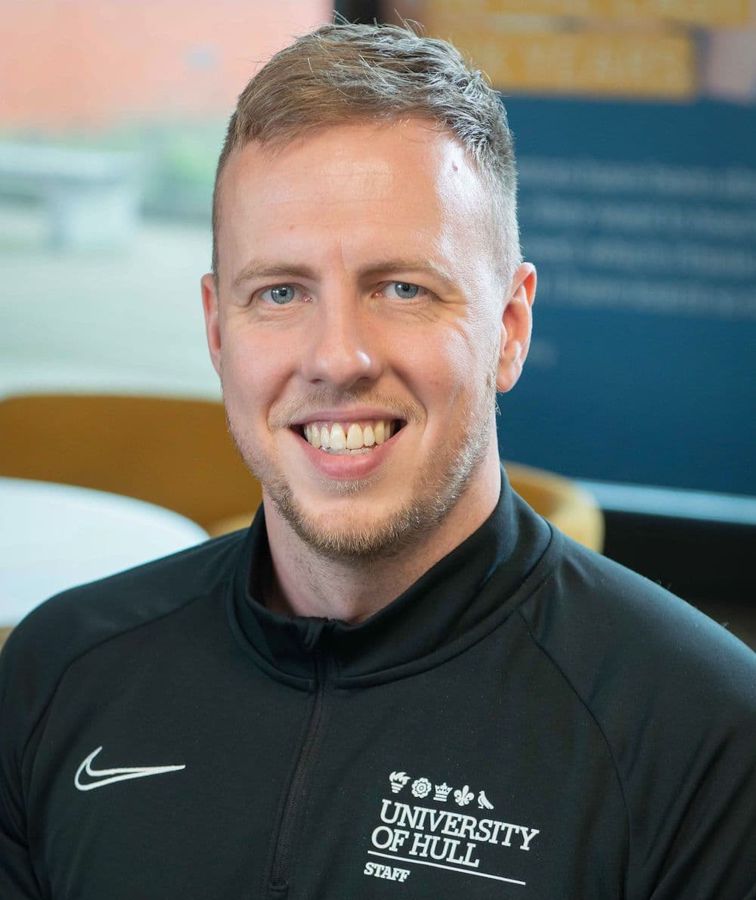
Dr Ben Oliver
Lecturer
Ben is our programme director who joined the Sport Rehabilitation lecturing team in 2020. Alongside working in rugby union and directing two private sports injury clinics, he is the module leader for Clinical Skills.
Entry Requirements
What do I need?
At Hull, you're a name, not a number. It's not just about the grades - we'll look at your whole application.
If you're not eligible for direct entry to this course, we may recommend a foundation year as an alternative route to studying for a degree.
To discuss your options, send us an enquiry or call us from 8am on Results Day on 01482 466100.
Every year, hundreds of students join the University of Hull through Clearing for all sorts of reasons and go on to achieve great things. Learn more about Clearing.
Qualification types
We accept a wide range of qualifications and combinations of qualifications, including A levels, BTECs and other accepted qualifications.
We don’t just see what you’re like on paper, we see you. All of you. Your achievements, work experience, music and sport qualifications and the projects you’ve been involved in. We want to hear it all.
Fees & Funding
How much is it?
Tuition fees for 2027 entry have not been confirmed. Please use 2026-27 information as a guide.
For UK students, our standard course fee is £9,790 per year. Keep in mind that some courses are longer - for example, spending your third year abroad will make your degree four years in total.
If you choose to study a foundation year as part of your course, the fee is £5,760.
How do I pay for it?
You can take out a tuition fee loan to cover the full cost of your course. Once you’ve successfully applied for this, you don’t need to do anything else – the money is sent straight to us.
You can also take out a maintenance loan of up to £10,544 a year to cover your living costs, depending on your household income.
Remember, you won’t start paying your loans back until you’ve left university and earn more than £25,000 per year.
See our full fees and funding information for more details and to find out what support we can offer.
Foundation Year Fee
£5,760
Standard Tuition Fee
£9,790 / year
The amount you pay may increase each year, in line with inflation - but capped to the Retail Price Index.
Future prospects
You’ll graduate with clinical skills in the prevention, assessment and management of neuro-musculoskeletal injuries.
Our students go on to work with sports clubs at all levels, in the military, in private practice and with the NHS. Others find their professional skills are sought by employers across the graduate job market.
Our careers team will be on-hand to give you expert advice and training, and you’ll have the chance to network with a wide range of employers throughout your degree as part of our annual Student Thesis Conference.
Check out our video to discover how Sport, Exercise, and Rehabilitation Careers provide students with the chance to turn their passion for physical activity into a fulfilling career, empowering them to enhance lives through fitness, recovery, and overall well-being.
Become part of the next generation of futuremakers
Like what you've seen? Then it's time to apply.
The standard way is to apply through UCAS. This will give you the chance to showcase your skills qualities and passion for the subject, as well as providing us with your academic qualifications.
Not ready to apply yet?
Visit our next Open Day, and see all that the University of Hull has to offer. Talk to our lecturers about your subject, find out what university is really like from our current students, and take a tour of our beautiful campus and amazing facilities.
You may also be interested in...
BSc (Hons) Physiotherapy
Undergraduate
Study in the award-winning Allam Medical Building on a programme developed to help meet a local and national shortfall in qualified physiotherapists.
B160
BSc (Hons) Sport and Exercise Science
Undergraduate
Access world-class health & performance equipment with our BSc Sport & Exercise Science degree. Apply today to begin applying the theory in the real-world.
C610
BSc (Hons) Sports Coaching and Performance Science
Undergraduate
Learn theoretical knowledge from expert coaches with our BSc Sports Coaching & Performance Science degree. Apply today for real-life coaching experience.
CB69
BSc (Hons) Sport and Exercise Science with Nutrition
Undergraduate
Study BSc Sport and Exercise Science with Nutrition and apply theory in real-world health and performance settings. Apply now to get hands-on experience.
C616
All modules presented on this course page are subject to availability and this list may change at any time.