Services for business
PFRlab
Our Property-level Flood Resilience Innovation and Testing Laboratory supports industry to bring safe and effective flood protection measures to market
Get in touch
Our Property-level Flood Resilience Innovation and Testing Laboratory supports industry to bring safe and effective flood protection measures to market
Get in touch
PFRlab is approved by Kiwa Ltd to undertake testing in support of British Standard BS 851188.
Products certified by Kiwa to this standard are eligible for inclusion in the Environment Agency PFR Framework.
For more information on testing and certification, email us at PFRlab@hull.ac.uk


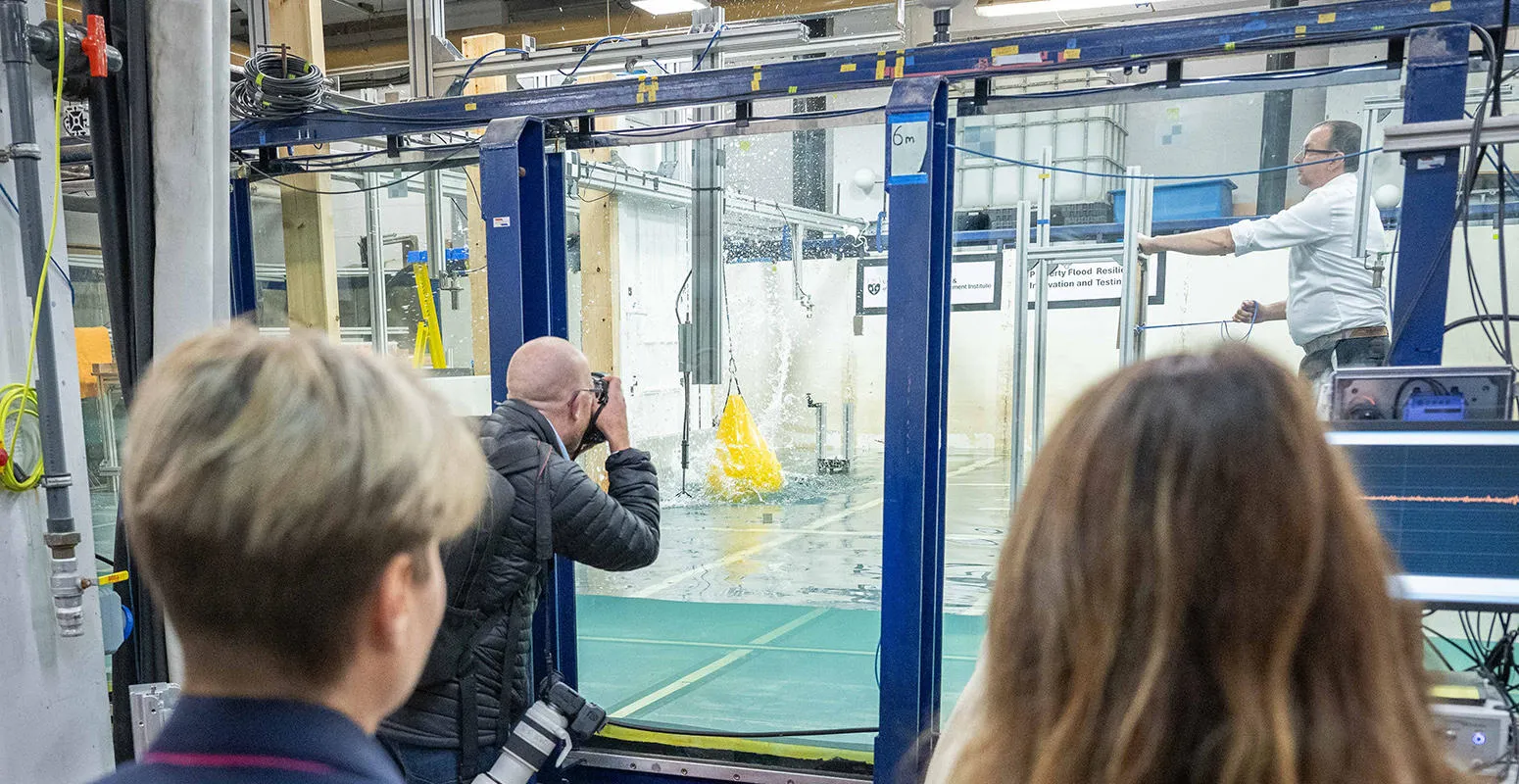
The PFRlab is the University of Hull’s state-of-the-art, independent innovation and testing laboratory, located at The Deep aquarium in Hull. Developed in collaboration with the Environment Agency and Flood Re, the PFRlab has a dual remit to innovate and test PFR products. The lab is equipped with adaptable testing enclosures and high-resolution monitoring systems, enabling rigorous evaluation under realistic flood conditions.
Flooding is one of the most significant climate-related risks, with 6.3 million UK homes now at risk from rivers, seas, and surface water. The number is increasing year on year and could reach 8 million by 2050.
For homeowners and businesses, the financial and emotional impact can be devastating. Property Flood Resilience (PFR) products, like flood doors and barriers, can help to hold back flood water and speed up recovery. However, until recently, the PFR market has faced barriers to innovation from high testing costs and limited access to appropriate facilities. These challenges restrict innovation and delay the availability of reliable products for those who need them most.

Experimental Officer

PFR Innovation and Testing Technician
Consultancy Manager

The University of Hull’s PFRlab is designed to transform this landscape. By providing independent, cost-effective, and flexible innovation and testing, the PFRlab enables industry to bring products to market faster and at lower cost. This increased capacity will:
Ultimately, the PFRlab will help protect homes, businesses, and communities, reducing the social and economic impact of flooding.
The PFRlab provides state-of-the-art measurement and instrumentation, combined with expert analysis and insight. The lab replicates real-world flood scenarios and can create:
Testing follows a carefully controlled sequence, providing manufacturers with robust evidence of product performance. PFRlab is approved by Kiwa Ltd to undertake testing in support of British Standard BS 851188-2019+A1-2021.
The lab’s innovation focus helps companies develop and refine designs, improving performance, durability and usability. By growing the evidence base, PFRlab is also contributing to evolving testing standards.
PFRlab offers a unique opportunity to collaborate on solutions that make property-level flood resilience measures more accessible, affordable, and effective – supporting a safer, more resilient future for millions of residential and business properties.

New PFRlab research, commissioned by Flood Re, compared low-cost temporary measures to stop floodwater entering homes.
The research found that flexible synthetic rubber tape reduced water leakage by 99% compared with an unprotected door and is highly effective. Duct tape reduced leakage by 97-98%, combining strong performance and affordability with ease of use.
Sandbags remain a symbol of flood protection, but these tests turn that assumption on its head... some relatively simple and affordable products can do a much better job.Jonathan Kassian
Head of Flood Resilience, Flood Re
The report: Testing the Performance of Temporary Property Flood Resilience Solutions is available here.
Forget sandbags, tape can keep out 99% of flood water
2 mins
If you manufacture PFR products or are exploring innovative flood resilience solutions, the University of Hull’s PFRlab can help you: