 Available in Clearing



Want to write music for a living? Join our thriving creative community of performers, composers, producers, music psychologists, and fellow songwriters.
To thrive in today’s fast-moving music culture, you’ll need a wide range of musical and technical skills. And to be able to work confidently with others across professional contexts.
At Hull, you not only learn about music. You learn on the job, by making music. You work on major creative projects – both on your own and with like-minded creatives. Think live gigs, recordings, broadcasts, collaborations that span a range of genres, and more…

Professional software
such as Pro Tools and Ableton

Hit the right note
in our state-of-the-art concert hall

Industry-standard
studios and rehearsal rooms

Close links
with Opera North and the Royal Philharmonic Orchestra

Industry alliance
with RPO musicians
About this course
BA Music (Songwriting) is a variant of the BA Music programme. So you’ll share the same modules as other BA Music students. But when it comes to options within modules, you’ll focus on songwriting.
You'll study a range of technical skills to enable you to realise your best work. Project management, music theory, and lyric analysis. Fluency with key pieces of music software. Research skills, social media skills, and festival programming.
You'll receive robust training in the critical and contextual dimensions of the study of music. Working with expert staff to explore, interrogate and challenge received wisdom about the value, status and significance of music in our society. Your practical work will culminate in a large-scale project that will be a stepping stone into your chosen career.
And you can tap into our partnerships with the Royal Philharmonic Orchestra (RPO) and Opera North. RPO hold masterclasses and offer career advice. As well as ensemble coaching, one-to-one tuition, and work experience.
Music sounds better with us
Foundation year
A foundation year at the University of Hull gives you a solid grounding of knowledge and boosts your academic skills, so you can progress on to your chosen programme with confidence.
The foundation course you enrol on may not be an exact match to your chosen degree, but don’t worry. Our foundation courses combine content from multiple related courses in the same subject area, giving you more flexibility and choice about the degree path you take.
For example, if you apply for a Music Foundation Year, you’ll join our Media Foundation course. So, if you decide to switch - say, from Music to Graphic Design - you can do so without restarting your foundation year.
Module options
Each year, you’ll study modules worth a certain number of credits, and you need 120 credits per year. Most modules are 20 credits – so you’ll study six modules each year. Some longer modules, such as a dissertation, are worth more. In these cases, you’ll study fewer modules - but the number of credits will always add up to 120. Some modules are compulsory, some are optional, so you can build a course that’s right for you.
No filters selected
Preparing for Learning in Higher Education
This module is designed to give you the best possible start to your university studies, making sure you have all the essential skills you need to succeed. Through lectures and workshops we will teach you how to write in an academic style, how to find quality sources, and how to reference work, culminating in writing up a mini-research project.
compulsory
20 credits
Foundation in Data Analysis
Develop a strong foundation in data collection and analysis. This module will introduce you to qualitative and quantitative data and how to analyse it; the collection of primary and secondary data; the production of high-quality graphics; and report writing.
compulsory
20 credits
Group Challenge (Humanities)
Formulate and execute a group led enquiry into texts, cultural artefacts, film, music or dance. You'll explore their topics in groups at supervised workshops and develop questions on the cultural object relates to the living world of human experience, as well as developing your own methods to answer these questions.
compulsory
20 credits
Research in the Humanities, Social Sciences and Education
This module will equip you with the necessary skills to conduct and analyse research in a specific interest, supported by academics within your subject. You'll navigate through the research process, from identifying an area of interest to presenting findings to your peers.
compulsory
20 credits
Introduction to Study in the Humanities
This module equips you with a suite of analytical and theoretical tools to support you as you progress along your academic journey. You'll develop an interdisciplinary understanding of approaches to study in the humanities by working with a variety of resources, including novels, films and aspects of the visual arts.
compulsory
20 credits
Academic Writing Skills
Developing confidence in expression, oral as well as written, is a key feature of this module, which aims to familiarise you with university submission and assessment procedures. This is a clear building block towards your degree programme and places you at a distinct advantage when you move into the following year.
compulsory
20 credits
Creating Recorded Music
Writer? Performer? Producer? Whatever your focus, you’ll work with fellow musicians to fully realise a musical recording. You’ll learn how to collaborate with others, each with different skills and roles, to create original music (including songwriting, instrumental works, electronic tracks and anything in-between) or to capture performance as a recorded artefact. You’ll finish the module with a portfolio-ready work.
core
20 credits
Creating Live Music
Channel your creativity into a live music event to develop your technical and artistic skills whatever your musical interests. You’ll collaborate with music and music production students to create a unique and original live music event, alongside developing core skills in project management, repertoire development and artistic presentation.
core
20 credits
Core Music Techniques
How does music work? How is it put together? Providing you with an essential proficiency in music theory and enabling you to realise your creative projects, you will develop your understanding of notation, harmony, melody, rhythm, alongside listening skills. You will form a portfolio for your final assessment from tasks across a variety of musical styles and techniques.
core
20 credits
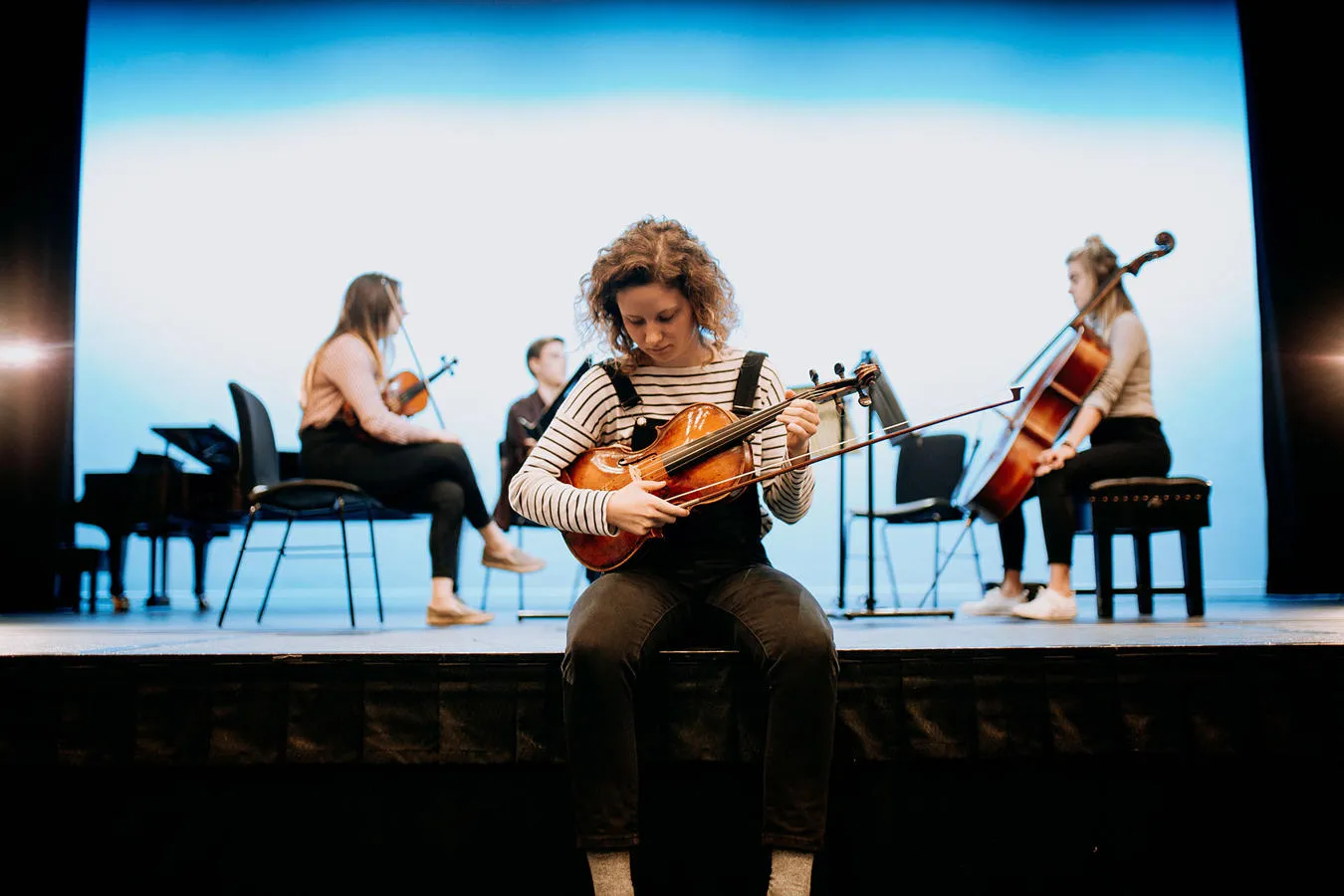
Can you make a living from music? You can here.
 Featured module
- optional
- 20 credits
How do you turn your passion for music into a successful career? This module helps you explore the many professional pathways within today’s vibrant and growing music industry.
You’ll investigate the roles that interest you, gain insight into what professionals in the sector actually do, and learn how to position yourself for future opportunities.
Through research and reflection, you’ll develop a clear understanding of your chosen field and the steps needed to pursue it.
Plan your path, build your confidence, and take the first step towards your future in the music industry.
Our facilities
Watchlist
Dr Mark Slater
Course overview
2 mins
The Future of Music
Course Highlight
7 mins
Humber Street Sesh
Course Highlight
2 mins
Featured academics
From DJs to band members, stage performers to session musicians, our performance-led staff are active in making music themselves. And they bring their passion and experience into everything you learn.
So you can be sure you’re getting a great education.

Dr Rowan Oliver
Senior Lecturer
Before joining the University of Hull, Rowan spent several years touring the world as the drummer in Goldfrapp (among various other musical exploits). He continues to record and perform internationally as a session musician.
Entry Requirements
What do I need?
At Hull, you're a name, not a number. It's not just about the grades - we'll look at your whole application.
If you're not eligible for direct entry to this course, we may recommend a foundation year as an alternative route to studying for a degree.
To discuss your options, send us an enquiry or call us from 8am on Results Day on 01482 466100.
Every year, hundreds of students join the University of Hull through Clearing for all sorts of reasons and go on to achieve great things. Learn more about Clearing.
Qualification types
We accept a wide range of qualifications and combinations of qualifications, including A levels, BTECs and other accepted qualifications.
We don’t just see what you’re like on paper, we see you. All of you. Your achievements, work experience, music and sport qualifications and the projects you’ve been involved in. We want to hear it all.
Fees & Funding
How much is it?
Tuition fees for 2027 entry have not been confirmed. Please use 2026-27 information as a guide.
For UK students, our standard course fee is £9,790 per year. Keep in mind that some courses are longer - for example, spending your third year abroad will make your degree four years in total.
If you choose to study a foundation year as part of your course, the fee is £9,790.
How do I pay for it?
You can take out a tuition fee loan to cover the full cost of your course. Once you’ve successfully applied for this, you don’t need to do anything else – the money is sent straight to us.
You can also take out a maintenance loan of up to £10,544 a year to cover your living costs, depending on your household income.
Remember, you won’t start paying your loans back until you’ve left university and earn more than £25,000 per year.
See our full fees and funding information for more details and to find out what support we can offer.
Foundation Year Fee
£9,790
Standard Tuition Fee
£9,790 / year
The amount you pay may increase each year, in line with inflation - but capped to the Retail Price Index.
Future prospects
You’ll graduate with essential skills for the music industry, plus, a professional portfolio of material for your CV. You’ll learn how to communicate confidently, both through your craft and face-to-face. You’ll also have access to our network of professional partners, providing opportunities for live projects, work experience, masterclasses, and more.
Some students set up record labels before they graduate. Others carve out their own careers in the industry. Our graduates go on to become musicians, composers, singer-songwriters, and recording artists. They also pursue careers as radio producers, music promoters, and events managers, as well as music therapists, teachers and journalists.
Become part of the next generation of futuremakers
Like what you've seen? Then it's time to apply.
The standard way is to apply through UCAS. This will give you the chance to showcase your skills qualities and passion for the subject, as well as providing us with your academic qualifications.
Not ready to apply yet?
Visit our next Open Day, and see all that the University of Hull has to offer. Talk to our lecturers about your subject, find out what university is really like from our current students, and take a tour of our beautiful campus and amazing facilities.
You may also be interested in...
BA (Hons) Music
Undergraduate
Forge your musical future – with pathways in Performance, Songwriting, Popular Music, and Community and Education.
W300
BA (Hons) Music (Popular Music)
Undergraduate
Become part of a creative community of performers, composers, songwriters, producers, music psychologists, and writers.
W305
BA (Hons) Music Production
Undergraduate
Get music-industry ready with a degree designed to build your skills, experience and portfolio of production projects.
W370
BA (Hons) Music (Performance)
Undergraduate
Pursue your creative endeavours - through live performances on stage, studio recordings, broadcasts, and concerts and gigs in the region.
W303
BA (Hons) Music (Community and Education)
Undergraduate
Gain the skills to become a peripatetic music teacher, a classroom specialist, an animateur, or an arts practitioner working with diverse communities.
W306
All modules presented on this course page are subject to availability and this list may change at any time.