



Gain the skills to unlock solutions that make people’s lives better. From manufacturing and the medical sector, to the automotive, aerospace and construction industry.
From day one, we treat you as a trainee engineer. The modules you’ll study encourage project-based learning. And you’ll get the chance to plan, build and test your own prototypes.
You can even spend a whole year on a mechanical engineering industrial placement. Past students have worked with the likes of Reckitt, Airbus, Virgin Media, Howdens, IBM, BMW Group, Siemens, Microsoft, and Smith & Nephew.
This course is accredited by


Boost your CV
with a placement year

Build a racing car
with Hull Electric Racing Team

Direct route
to Chartered Engineer status1

Common first year
across engineering courses, so you can swap pathways2

Fully accredited
including the IChemE, the IMechE, the IET and the IPEM

Integrated Masters option
Undergraduate and postgraduate study combined

Safely learn to use
machinery such as lathes, milling machines and pillar drills in our purpose built workshop
About this course
As well as our three-year mechanical engineering course, we offer four- and five-year options with the chance to transfer anytime. Choose from a built-in placement year in industry or an integrated Masters (MEng) – or both. Imagine it. A whole year working for one of the biggest names in the technology, manufacturing or automotive industries. And like all our engineering courses, Mechanical Engineering shares a common first year. That means you can switch degrees in second year if you want to choose a different pathway.
Hull provides you with everything you need to excel after graduating. In your first year, you’ll gain the core theoretical and practical skills you need throughout your time here and beyond. CAD, programming and control and thermo fluids are just a few of the areas you’ll cover. The mathematics module is specifically geared towards engineering applications. You’ll also take part in Global Challenge, where you’ll work in a team to tackle a design and build project.
But it’s not all study and work. There are lots of extra-curricular activities for you to get involved with as well. Join our thriving Robotics Society, and become part of our Hull Electric Racing Team (HERT). As a member of HERT, you’ll help to build a single seater racing car and compete against other students at Silverstone.
Grab life by the wheel. Because a bright future is in your hands.
Integrated Masters
Integrated masters degrees are four-year programmes that include a postgraduate year, giving you the chance to deepen your knowledge and graduate with a higher-level qualification - like an MEng, MPhys, MSci - instead of a standard BA, BSc or BEng.
The final year is set at masters level and offers advanced skills, specialist modules, and often a significant research project or industry-focused experience. It’s ideal if you're aiming for a career in research, want to stand out in a competitive job market, or are thinking about progressing to a PhD. You’ll finish your degree more qualified, more confident, and more prepared for what’s next.
Module options
Each year, you’ll study modules worth a certain number of credits, and you need 120 credits per year. Most modules are 20 credits – so you’ll study six modules each year. Some longer modules, such as a dissertation, are worth more. In these cases, you’ll study fewer modules - but the number of credits will always add up to 120. Some modules are compulsory, some are optional, so you can build a course that’s right for you.
No filters selected
Engineering Design Challenge
Develop and enhance a range of professional skills as a basis for professional registration as an Incorporated or Chartered Engineer.
compulsory
20 credits
Fundamentals of Engineering
Introducing the key principles and concepts of mechanical, and electrical and electronic engineering, ranging from digital electronics to basic stress analysis concepts.
compulsory
20 credits
Mathematics for Engineers
Gain knowledge of the characteristics of a range of functions and techniques appropriate to engineering, developing expertise in analysis, interpretation and problem solving.
compulsory
20 credits
Practical Skills for Engineers
An introduction to key experiments and construction skills required for electrical and electronic engineers, as well as hands-on experience in the mechanical engineering manufacturing workshop.
compulsory
20 credits
Programming and Digital Logic
Communication of mathematical problems and solutions, as well as logic simulation and C programming results for academic, specialist and non-specialist audiences.
compulsory
20 credits
Engineering Thermodynamics and Fluid Mechanics
Gain knowledge, comprehension and hands-on experience of using a range of mathematical functions and techniques appropriate to the application of Engineering Thermofluids to engineering processes.
compulsory
20 credits
Business Management and Societal Engagement for Engineers
Student teams will explore engineering challenges through the planning commercially viable solutions using project-based learning. The module covers project management techniques, self-marketing and employability skills, business organisation and finance, and the development of a business plan. Students also examine engineering standards, data analysis, and legal compliance using examples from industry.
compulsory
20 credits
Materials and Manufacture
Explore the reasons engineering structures can fail, sometimes unexpectedly, through fatigue and fast fracture, corrosion and creep, as well as processes to reduce such problems.
compulsory
20 credits
Mathematics and Fluid Mechanics for Engineers
Theories and applications in fluid mechanics and engineering mathematics essential for engineering practice are covered, including advanced mathematical concepts such as multivariable calculus and vector functions, alongside fluid mechanics topics such as hydrostatics, flow types (laminar, transitional, turbulent) and energy/momentum conservation laws.
compulsory
20 credits
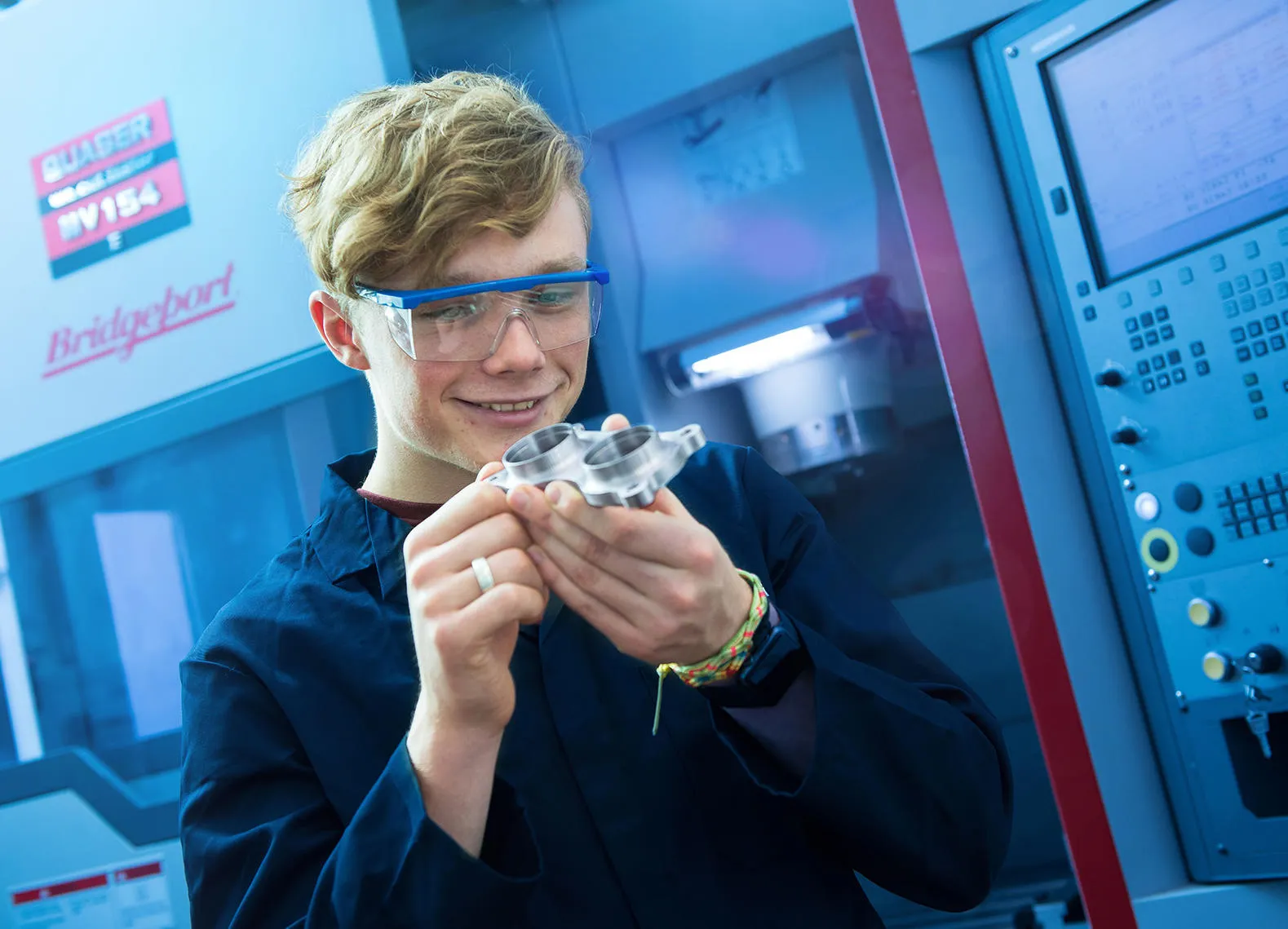
Got a winning idea? Put it to the test.
 Featured module
- compulsory
- 20 credits
What does it take to turn a concept into a fully engineered product? This module challenges you to design solutions that balance creativity, technical performance, and real-world constraints.
You’ll work through the complete engineering design process - from sketches and concept generation to CAD modelling, simulation, and detailed technical drawings. Along the way, you’ll consider client needs, manufacturing limits, cost, and available resources to develop practical, buildable solutions.
Using industry-relevant tools such as CAD and finite element analysis (FEA), you’ll test and refine your designs against real world forces, heat, vibration, and other physical effects.
Think like a designer. Analyse like an engineer. Create solutions ready for the real world.
Our facilities
Watchlist
Dr Mark Walker
Course overview
2 mins
Engineering a freer future
Course Highlight
2 mins
Will Hughes
Student Story
2 mins
Engineering students drive to survive
Course Highlight
2 mins
Who's shaping your future? Engineering at Hull
Course Highlight
3 mins
Engineering Facilities
Course Highlight
1 min
The Gold Standard for Teaching
University life
1 min
Life on campus
University life
2 mins
Featured academics
Hull has an excellent reputation for teaching mechanical engineering, with lecturers and academics who have extensive links to industry across the country.
You’ll be studying with practising engineers whose research feeds directly into our course.

Dr Mark Walker
Lecturer in Sustainable Engineering Systems
Mark’s research supports the development of low-carbon energy, industrial and agricultural systems, especially those related to the circular economies in areas such as bioprocessing, bio-based production systems, and environmental biotechnology.
Dr Carolina Font Palma
Senior Lecturer in Mechanical Engineering
Dr Font Palma is Lecturer and Programme Director of Chemical Engineering. Carolina was awarded the prestigious RAEng/The Leverhulme Trust Research Fellowship 2020/2021.
Entry Requirements
What do I need?
This course has a range of tariffs for entry. Use the interactive slider to choose a number of points and see the course entry requirements.

Slide to set your points
A levels
BBB
BTEC
DDM
Equivalent qualifications and grades are accepted.
How to apply for this course
Most importantly, you need ambition. Together with our support and opportunities, you can go further than you ever thought possible.
Our typical offer for this course is 104-120 UCAS points. Our contextual offer is 104 points. But there’s no ceiling on ambition.
At least 80 points must come from A levels, BTEC, or other equivalent qualifications.
Remember, we look at your whole application – not just grades. Achievements, work experience, extracurricular activities: they all count here. We also consider qualifications and experience from the UK and worldwide that may not exactly match those listed.
Not sure if you’ll meet the entry requirements?
Talk to our Admissions team today. We’ll look at your circumstances, give you personalised guidance and help you understand your options, one of which could be a Foundation Year.
Fees & Funding
How much is it?
Tuition fees for 2028 entry have not been confirmed. Please use 2027-28 information as a guide.
For UK students, our standard course fee is £10,050 per year. Keep in mind that some courses are longer - for example, spending your third year abroad will make your degree four years in total.
If you choose to study a foundation year as part of your course, the fee is £10,050.
Thinking about a year in industry? This is £2,010 for UK students.
Planning a year abroad? This costs £1,505 for UK students.
Standard Tuition Fee
£10,050 / year
The amount you pay may increase each year, in line with inflation - but capped to the Retail Price Index.
How do I pay for it?
You can take out a tuition fee loan to cover the full cost of your course. Once you’ve successfully applied for this, you don’t need to do anything else – the money is sent straight to us.
You can also take out a maintenance loan of up to £10,544 a year to cover your living costs, depending on your household income.
Remember, you won’t start paying your loans back until you’ve left university and earn more than £25,000 per year.
See our full fees and funding information for more details and to find out what support we can offer.
Future prospects
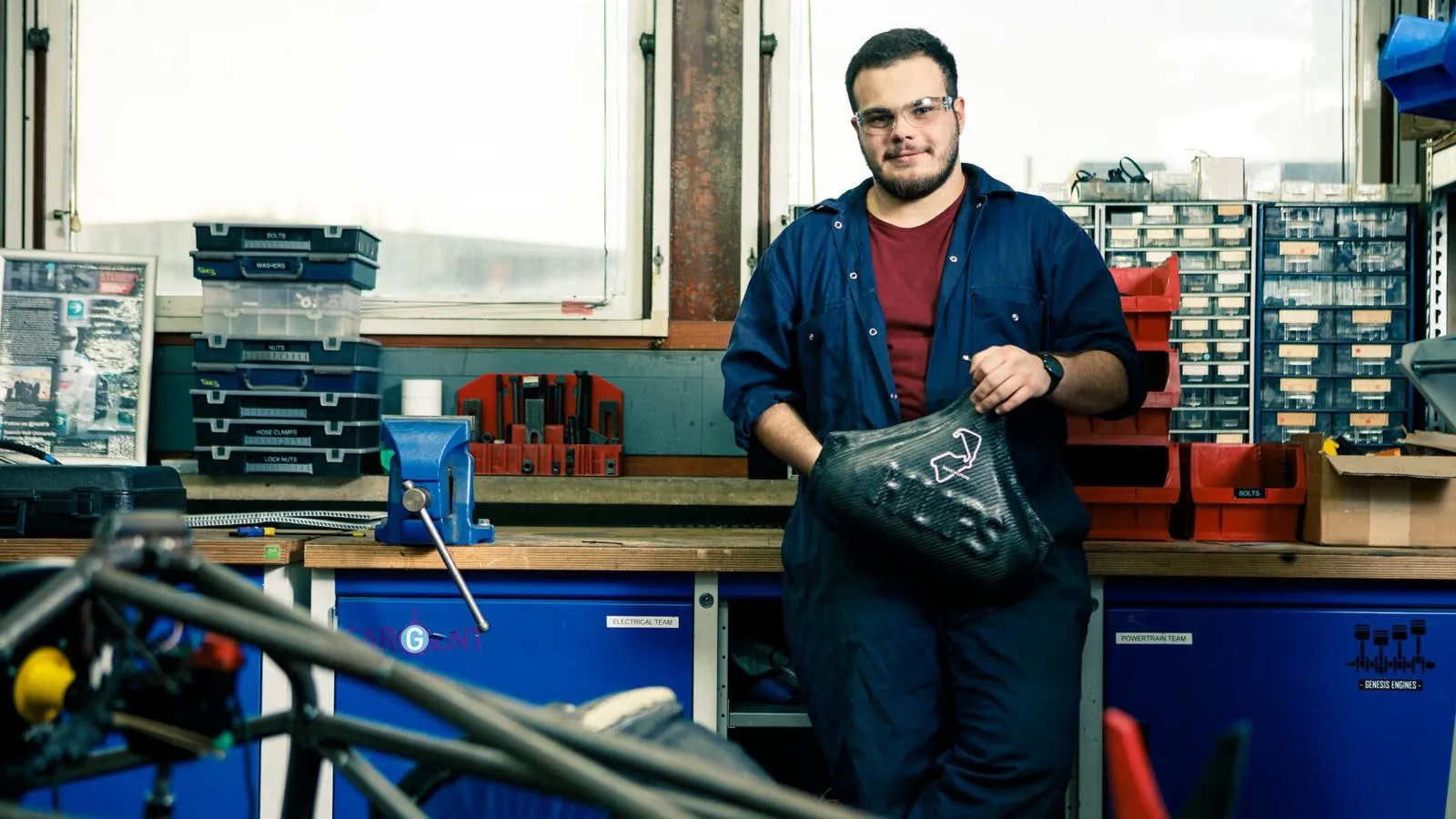
Mechanical engineers are involved in almost everything we use. From nanotechnology to healthcare equipment to planes, windfarms and even spacecraft.
Your transferable skills will open up careers across a range of industries. And with a national shortage of engineers, you're likely to be in high demand. Our graduates have gone on to work with BAE Systems, British Energy, the Royal Navy, Williams F1, Rolls-Royce, and more.
Our course is fully accredited. This shows employers you’ve studied a degree that meets globally recognised standards. It also puts you on the pathway to Chartered Engineer status. We’re also in the process of becoming accredited by the Women in Engineering Society.
Become part of the next generation of futuremakers
Like what you’ve seen? Then it’s time to apply.
The standard way to apply is through UCAS. This will give you the chance to showcase your skills, qualities and passion for the subject, as well as providing us with your academic qualifications.
Not ready to apply yet?
Visit our next Open Day, and see all that the University of Hull has to offer. Talk to our lecturers about your subject, find out what university is really like from our current students, and take a tour of our beautiful campus and amazing facilities.
You may also be interested in...
BEng (Hons) Chemical Engineering
Undergraduate
Further your knowledge and boost career prospects by applying for our BEng Chemical Engineering degree, and learn alongside industry leaders.
H810
BEng (Hons) Civil Engineering
Undergraduate
Ready to shape the future? Our Civil Engineering degree course is designed for hands-on learners eager to innovate sustainable infrastructure. Apply now.
H201
BEng (Hons) Electrical and Electronic Engineering
Undergraduate
Tailor your degree through a wide variety of work placements or by choosing one of our optional pathways in youth work, special needs & inclusion or TESOL.
H604
BEng (Hons) Biomedical Engineering
Undergraduate
This accredited biomedical science degree equips you with the knowledge to work at the cutting edge of health research, driving innovation that saves lives
H160
BSc (Hons) Robotics and Artificial Intelligence
Undergraduate
See how robots and AI are transforming our lives and access industry-standard facilities on Hull's BSc / MEng Robotics and Artificial Intelligence degree.
HI40
Our degrees are fully accredited by the Institution of Engineering and Technology (IET). Our BEng courses fully meet the academic requirements for registration as an Incorporated Engineer, and partly for Chartered Engineer. Our MEng degrees fully meet the academic requirements for becoming a Chartered Engineer.
All of our BEng engineering courses share a common first year. This means you can switch degrees in your second year if you want to choose a different pathway.
All modules on this course page are subject to availability and this list may change at any time.