 Available in Clearing



Create video games, write stories and gain key employability skills for one of the U.K’s fastest growing creative industries on this Games Design and Creative Writing Degree.
Our programme encourages you to create cutting-edge games and craft unforgettable narratives through mastery of a technical skillset and an immersive approach to story. Join the No. 1 community for student satisfaction and develop your unique style through Game Jams, Open-Mics and Student-Led Literary magazines.
Join our exciting, unique programme that opens doors to a vast array of employment opportunities and develop your creativity and craft to industry-standard and beyond.

Joint 1st in the UK
for Student Satisfaction
The Complete University Guide, 2027
3rd in the UK
for Computer Games and Animation
Daily Mail, 2025
12th in the UK
for Academic Support
National Student Survey (NSS) 2025, HEIs only

Cutting-edge tech
like our Virtuix Omni VR treadmill

Industry-standard
software and hardware

BAFTA-Winning experts
and bestselling authors teach on this course.

Gain industry experience
through Screen Yorkshire

Lightening fast 3D rendering
with Viper Supercomputer

Get creative in our
Media Hub with VR and design labs
About this course
Games Design and Creative Writing are a perfect pairing – you need both to create successful games, best-selling narratives and interactive storytelling.
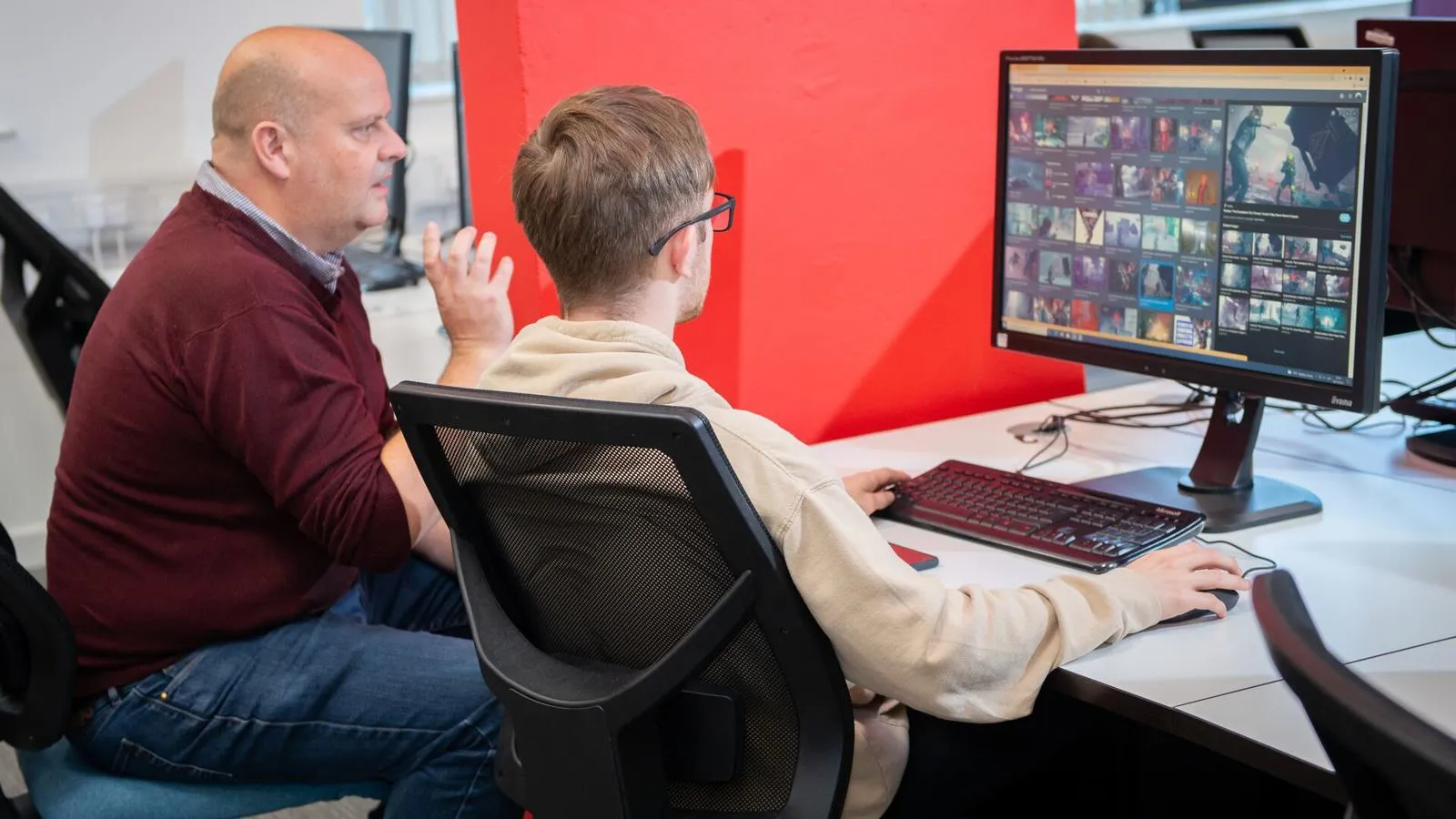
Learn from experts who’ve worked on BAFTA-winning games and led projects across Europe, while getting hands-on experience with industry-standard facilities. You’ll have access to cutting-edge technology including our Virtual Reality lounge, complete with Virtuix Omni VR Treadmill and fully equipped Mac and PC labs with the latest digital media software.
You’ll hone your narrative craft through practical workshops and open discussions, taking advantage of the welcoming and student-focused community. Develop key skills to enhance your writer’s approach and experiment with genre, form & style as you create unique and exciting narratives, from Fantasy and Science Fiction to scripts and short stories, poems and non-fiction.
Our classes focus on co-creation and the student voice. You’ll collaborate with students across a range of disciplines, honing your skills in communication, problem-solving and teamwork. You’ll workshop projects with your peers, deepening your skills through peer-support and regular feedback to hone your craft and skillset with each class.
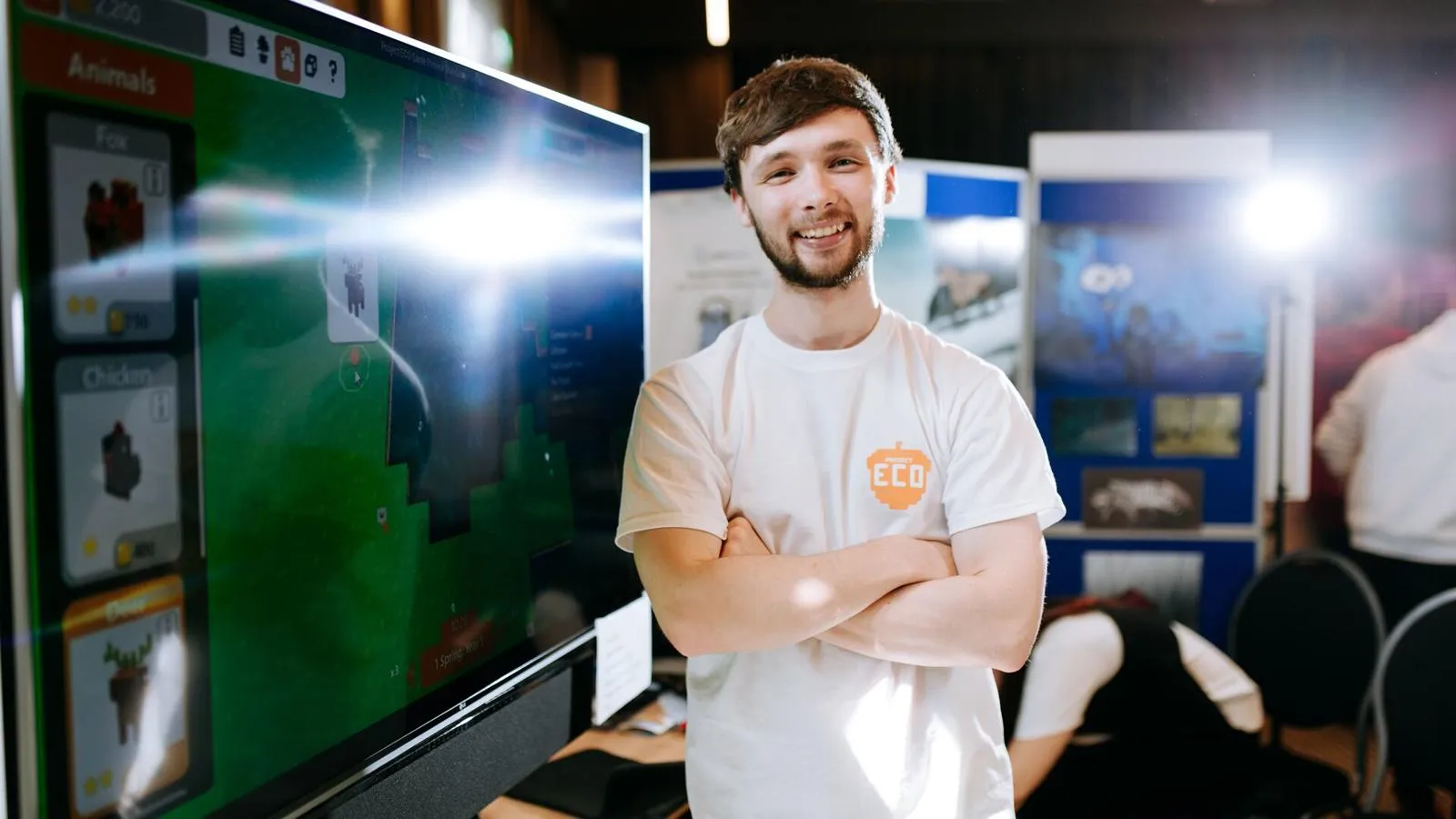
With our strong industry connections, you’ll enjoy study trips, guest lectures and writing challenges. Get involved beyond the classroom by joining the Game Republic’s annual Student Showcase to present your work to top employers, and design, edit & publish your writing in our student-led magazine Document 1.
Play your part in tomorrow's world today
Foundation year
A foundation year at the University of Hull gives you a solid grounding of knowledge and boosts your academic skills, so you can progress on to your chosen programme with confidence.
The foundation course you enrol on may not be an exact match to your chosen degree, but don’t worry. Our foundation courses combine content from multiple related courses in the same subject area, giving you more flexibility and choice about the degree path you take.
For example, if you apply for a Music Foundation Year, you’ll join our Media Foundation course. So, if you decide to switch - say, from Music to Graphic Design - you can do so without restarting your foundation year.
Module options
Each year, you’ll study modules worth a certain number of credits, and you need 120 credits per year. Most modules are 20 credits – so you’ll study six modules each year. Some longer modules, such as a dissertation, are worth more. In these cases, you’ll study fewer modules - but the number of credits will always add up to 120. Some modules are compulsory, some are optional, so you can build a course that’s right for you.
No filters selected
Preparing for Learning in Higher Education
This module is designed to give you the best possible start to your university studies, making sure you have all the essential skills you need to succeed. Through lectures and workshops we will teach you how to write in an academic style, how to find quality sources, and how to reference work, culminating in writing up a mini-research project.
core
20 credits
Introduction to Study in the Humanities
This module equips you with a suite of analytical and theoretical tools to support you as you progress along your academic journey. You'll develop an interdisciplinary understanding of approaches to study in the humanities by working with a variety of resources, including novels, films and aspects of the visual arts.
core
20 credits
Research in the Humanities, Social Sciences and Education
This module will equip you with the necessary skills to conduct and analyse research in a specific interest, supported by academics within your subject. You'll navigate through the research process, from identifying an area of interest to presenting findings to your peers.
core
20 credits
Group Challenge (Humanities)
Formulate and execute a group led enquiry into texts, cultural artefacts, film, music or dance. You'll explore their topics in groups at supervised workshops and develop questions on the cultural object relates to the living world of human experience, as well as developing your own methods to answer these questions.
compulsory
20 credits
Foundation in Data Analysis
Develop a strong foundation in data collection and analysis. This module will introduce you to qualitative and quantitative data and how to analyse it; the collection of primary and secondary data; the production of high-quality graphics; and report writing.
compulsory
20 credits
Academic Writing Skills
Developing confidence in expression, oral as well as written, is a key feature of this module, which aims to familiarise you with university submission and assessment procedures. This is a clear building block towards your degree programme and places you at a distinct advantage when you move into the following year.
compulsory
20 credits
Critical Studies Project
In order to create innovative and original game experiences, it’s important to understand where games came from and the current landscape of the games industry.
In this module you will explore the historical, social and political contexts of games, play and design. We’ll look at how to analyse games, how games get made, the people that make them and games from a consumer perspective.
The module will perform analysis on video games and its industry including topics such as gender, representation, misogyny in video games, Law, ethics, regulation and censorship. will consider sustainable game development practices and generate original concepts for game designs that could “change the world”.
compulsory
20 credits
Facts into Art
Discover how to convert real life into good storytelling. Extend your creative writing skills by generating ideas from daily life, and crafting them into well-conceived, skilled pieces.
compulsory
20 credits
Game Design & Prototyping
Ready to start turning your game ideas into reality and build the foundation for a career in game design? Then this is the module for you.
You’ll cover key principles like game objects, rules, mechanics, goals and conflict.
You’ll learn to apply these concepts by developing your own game ideas and bringing them to life in engines like Unity and Unreal.
With hands-on experience you'll build environments, prototype mechanics, and learn essential scripting skills.
You’ll also dive into production tools like iterative design and documentation. Giving you the skills to create and manage your own game projects.
Take the first step toward shaping the future of gaming today.
compulsory
20 credits

The end of your story is just the beginning
 Featured module
- core
- 20 credits
Want to see your story come to life on stage or screen? This module is your chance to make it happen.
You’ll dive into key elements like story, plot, character development, dialogue, structure, and adaptation.
You'll hone your skills in giving and receiving feedback, refining your craft, and growing as a writer.
You’ll work closely with other creatives, sharing ideas, inspiring each other and pushing one another to reach your full potential.
By the end, you'll have the tools and experience to turn your ideas into powerful scripts that can captivate audiences. Ready to bring your story to life? So are we.
Our facilities
Watchlist
Dr Ed Hurst
Course overview
2 mins
Student showreel
Course Highlight
3 mins
Featured academics
Study under experts who’ve worked on BAFTA-winning games and titles for Disney and Lucasfilm, alongside innovative authors and writers of fiction, non-fiction, poetry, fantasy and science fiction.
You’ll be taught be enthusiastic, expert staff who are gamers and storytellers as much as they are academics. Our lecturers have a diverse range of experience, from digital media and games design, to publishing and social media.

Stuart Lilford
Programme Director & Lecturer
Stuart began his career in the games industry before moving into teaching. He worked on three BAFTA-winning games and at prestigious companies such as Rare and Codemasters. He develops games independently, including the award-winning Time Stone.

Dr Edmund Hurst
Lecturer
A novelist and published author, Dr. Edmund Hurst’s focus is on Genre Fiction. Interested in Fantasy and Science Fiction, he achieved his PhD for the thesis: 'Dawnsmoke and the Influence of Character Tropes on the Construction of Fantasy Fiction.'
Entry Requirements
What do I need?
At Hull, you're a name, not a number. It's not just about the grades - we'll look at your whole application.
If you're not eligible for direct entry to this course, we may recommend a foundation year as an alternative route to studying for a degree.
To discuss your options, send us an enquiry or call us from 8am on Results Day on 01482 466100.
Every year, hundreds of students join the University of Hull through Clearing for all sorts of reasons and go on to achieve great things. Learn more about Clearing.
Qualification types
We accept a wide range of qualifications and combinations of qualifications, including A levels, BTECs and other accepted qualifications.
We don’t just see what you’re like on paper, we see you. All of you. Your achievements, work experience, music and sport qualifications and the projects you’ve been involved in. We want to hear it all.
Fees & Funding
How much is it?
Tuition fees for 2027 entry have not been confirmed. Please use 2026-27 information as a guide.
For UK students, our standard course fee is £9,790 per year. Keep in mind that some courses are longer - for example, spending your third year abroad will make your degree four years in total.
If you choose to study a foundation year as part of your course, the fee is TBC.
How do I pay for it?
You can take out a tuition fee loan to cover the full cost of your course. Once you’ve successfully applied for this, you don’t need to do anything else – the money is sent straight to us.
You can also take out a maintenance loan of up to £10,544 a year to cover your living costs, depending on your household income.
Remember, you won’t start paying your loans back until you’ve left university and earn more than £25,000 per year.
See our full fees and funding information for more details and to find out what support we can offer.
Foundation Year Fee
TBC
Standard Tuition Fee
£9,790 / year
The amount you pay may increase each year, in line with inflation - but capped to the Retail Price Index.
Future prospects
You’ll graduate ready for a range of exciting careers in the games industry and creative sector.
You’ll develop the essential skills that are needed in the rapidly growing game sector, as well as a professional-standard portfolio of both games and written work to showcase your unique abilities and key career prospects.
With transferrable skills such as communication, problem solving and collaboration, you’ll have the essential attributes graduates need to get into the creative industries. You’ll develop analytic and creative thinking, alongside resilience, motivation and curiosity – all skills prized by employers across the globe.
Our students have gone on to successful careers in games design, creative writing and multimedia production with roles including game designer, 2D or 3D artist, VFX artist, scriptwriter, publishing assistant, publicity and marketing.
The ability to showcase a creative mind through writing is a rare skill. Being able to tailor your messaging for different audiences will also give you a powerful advantage. Especially if you combine your professional portfolio with job-ready skills gained from work experience.
Become part of the next generation of futuremakers
Like what you've seen? Then it's time to apply.
The standard way is to apply through UCAS. This will give you the chance to showcase your skills qualities and passion for the subject, as well as providing us with your academic qualifications.
Not ready to apply yet?
Visit our next Open Day, and see all that the University of Hull has to offer. Talk to our lecturers about your subject, find out what university is really like from our current students, and take a tour of our beautiful campus and amazing facilities.
You may also be interested in...
BA (Hons) Game Design
Undergraduate
Take advantage of links to names like Microsoft and Epic Games on a BA Game and Entertainment Design degree at the University of Hull. Apply now.
W291
BA (Hons) Creative Writing and English
Undergraduate
Develop your confidence in writing by moving from building core skills to self-directed longer pieces of writing, while experimenting in different genres.
WQ83
BA (Hons) Creative Writing and Film Studies
Undergraduate
Develop your skills in writing and experimenting in different genres. You'll also look at film as art, history, culture, entertainment and commerce.
WW86
BA (Hons) Graphic Design
Undergraduate
Explore visual design, creative thinking, typography and more. As well as technical skills you'll develop knowledge in leadership and professional practice
W210
BA (Hons) English
Undergraduate
Our staff are experts in a range of literature from the medieval to the 21st century, providing the flexibility to pursue your passions.
Q300
BA (Hons) English Literature
Undergraduate
Study BA English Literature at the University of Hull, and get 24/7 access to the Brynmor Jones Library in the country's "most poetic city". Apply now.
Q305
Creative Writing is ranked in 1st place for Student Satisfaction (out of 50 institutions.) Complete University Guide 2025.
All modules presented on this course page are subject to availability and this list may change at any time.