 Available in Clearing


Looking for a more hands-on course? You’ve found it. Put your lab skills to good use on local hospital visits. And choose to spend a whole year on placement gaining real-world experience.
This is one of the fastest growing sectors of the economy. And thanks to our close links to the NHS and medical device companies, you’ll be right on the pulse of future trends in medical technology.
Our accredited course is a recognised qualification towards Chartered Engineer status. Plus, we offer an integrated Masters (MEng) option. So a degree from Hull will open doors to even more opportunities.

1st in the UK
for 'How often does feedback help you to improve your work'
National Student Survey (NSS) 2026, HEIs only
1st in the UK
for 'How easy is it to access subject specific resources (e.g. equipment, facilities, software) when you need them'
National Student Survey (NSS) 2026, HEIs only
2nd in the UK
for Teaching Quality
The Times and Sunday Times Good University Guide, 2026
3rd in the UK
for Student Experience
The Times and Sunday Times Good University Guide, 2026
This course is accredited by



Links with the NHS
and medical device companies

Access to
our Swift Additive Manufacturing Space, with the latest 3D printers, laser scanners and cutters

Direct route
to Chartered Engineer status

Fully accredited
including the IChemE, the IMechE, the IET and the IPEM

£1.5m state-of-the-art
biomechanics laboratory

Integrated Masters option
Undergraduate and postgraduate study combined

Boost your CV
with a placement year
About this course
Biomedical engineering deals with the development of medical devices. Particularly those related to tissue engineering and regenerative medicine used to replace or regenerate cells, tissues and organs. Through a blend of virtual learning systems and traditional teaching, you'll develop the techniques to solve these complex problems.
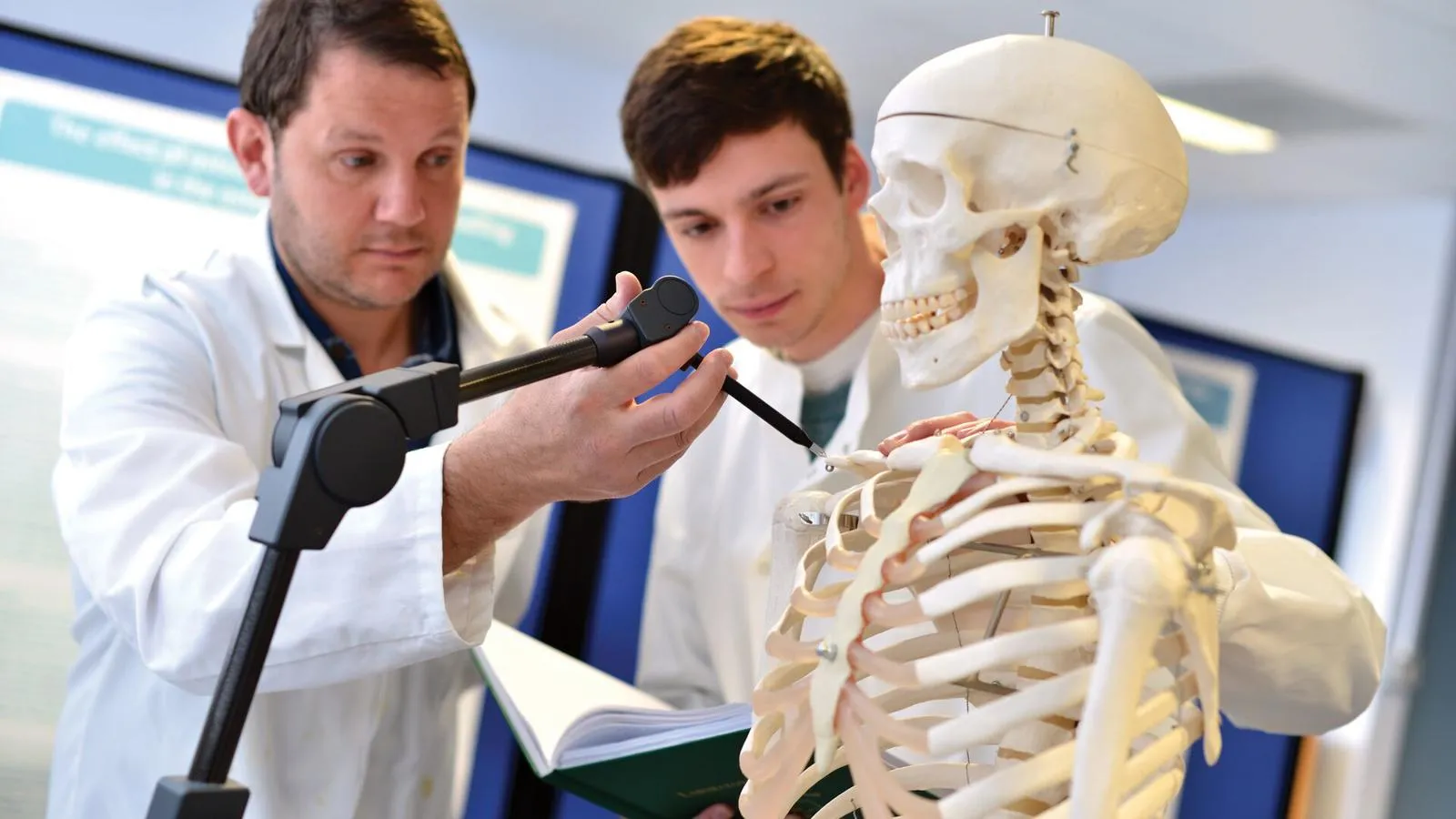
You’ll get hands-on with medical tech, including endoscopy and ultrasound. You’ll test biomaterials and medical devices, such as prosthetics and orthotics. You’ll practise taking physiological measurements through EMG and ECG. You'll learn practical dissection skills in the lab to gain a complete understanding of human anatomy and the medical engineering issues which may arise for surgeons. And you’ll also spend time in local hospitals getting first-hand experience of biomedical engineering in practice.
As well as our three-year course, we offer four and five-year options with the chance to transfer anytime in your degree. Choose from a built-in placement year or an integrated Masters (MEng) – or combine them both. And like all our engineering courses, Biomedical Engineering shares a common first year. That means you can switch degrees in your second year if you want to choose a different pathway.
Looking for a more hands-on degree? This is it.
Foundation year
A foundation year at the University of Hull gives you a solid grounding of knowledge and boosts your academic skills, so you can progress on to your chosen programme with confidence.
The foundation course you enrol on may not be an exact match to your chosen degree, but don’t worry. Our foundation courses combine content from multiple related courses in the same subject area, giving you more flexibility and choice about the degree path you take.
For example, if you apply for a Music Foundation Year, you’ll join our Media Foundation course. So, if you decide to switch - say, from Music to Graphic Design - you can do so without restarting your foundation year.
Module options
Each year, you’ll study modules worth a certain number of credits, and you need 120 credits per year. Most modules are 20 credits – so you’ll study six modules each year. Some longer modules, such as a dissertation, are worth more. In these cases, you’ll study fewer modules - but the number of credits will always add up to 120.
No filters selected
Preparing for Learning in Higher Education
This module is designed to give you the best possible start to your university studies, making sure you have all the essential skills you need to succeed. Through lectures and workshops we will teach you how to write in an academic style, how to find quality sources, and how to reference work, culminating in writing up a mini-research project.
core
20 credits
Group Challenge
Address one of the 21 key global challenges in engineering set out by the United Nations. Work in teams to identify key stakeholders, end users and potential funding sources, as well as producing an engineering solution for topics such as clean water, reusable energy, access to medical treatment and cleaner cities.
core
20 credits
Foundation Mathematics 1
This module delivers core mathematics skills to build a solid basis for future studies. You will study the following topics: factors, multiples, indices, fractions and standard form; algebra, linear and quadratic equations; averages and spread; functions, exponentials and logarithms; and right-angled triangles and trigonometry.
compulsory
20 credits
Foundation Mathematics 2
This module delivers core mathematics skills to build a solid basis for future studies.You will study the following topics: polynomials; sequences and series; complex numbers and trigonometry; and differentiation and integration.
compulsory
20 credits
Introduction to Physics 1
This is the first of two foundation year modules that prepare you for studying physics or mathematics at degree level. You will study the basics of mechanics, properties of matter, electricity and magnetism.
compulsory
20 credits
Introduction to Physics 2
This is the second of two foundation year modules that prepare you for studying physics or mathematics at degree level. You will study the basics of oscillations, waves, and quantum and nuclear physics.
compulsory
20 credits
Mathematics for Engineers
Gain knowledge of the characteristics of a range of functions and techniques appropriate to engineering, developing expertise in analysis, interpretation and problem solving.
compulsory
20 credits
Fundamentals of Engineering
Introducing the key principles and concepts of mechanical, and electrical and electronic engineering, ranging from digital electronics to basic stress analysis concepts.
compulsory
20 credits
Practical Skills for Engineers
An introduction to key experiments and construction skills required for electrical and electronic engineers, as well as hands-on experience in the mechanical engineering manufacturing workshop.
compulsory
20 credits
Our facilities
Watchlist
Dr Harriet Talbott
Course overview
2 mins
Engineering Facilities
Course Highlight
1 min
Engineering a freer future
Course Highlight
2 mins
Life on campus
University life
2 mins
Accommodation at Hull
University life
2 mins
Featured academics
You'll be taught by experienced engineering professionals, and by NHS clinicians and clinical engineers from local hospitals.
Biomedical Engineering at Hull is highly rated by our students, who go on to join a variety of career sectors.

Dr Louise France
Director of Learning and Teaching, Lecturer in Mechanical and Medical Engineering
Louise’s expertise lies in bioreactor development, biomaterials for wound care devices, and tissue-material interactions for medical devices. Her research forms part of the University Advanced Wound Care Cluster, working closely with Smith & Nephew.

Dr Harriet Talbott
Medical Engineering Programme Director; Lecturer in Medical Engineering
Harriet’s research focuses on the use of computational methods in investigating pathologies of the foot and ankle, with a focus on finite element analysis. During her PhD, she investigated the consequences of haemophilia on joint health in the ankle.
Entry Requirements
What do I need?
At Hull, you're a name, not a number. It's not just about the grades - we'll look at your whole application.
If you're not eligible for direct entry to this course, we may recommend a foundation year as an alternative route to studying for a degree.
To discuss your options, send us an enquiry or call us from 8am on Results Day on 01482 466100.
Every year, hundreds of students join the University of Hull through Clearing for all sorts of reasons and go on to achieve great things. Learn more about Clearing.
Qualification types
We accept a wide range of qualifications and combinations of qualifications, including A levels, BTECs and other accepted qualifications.
We don’t just see what you’re like on paper, we see you. All of you. Your achievements, work experience, music and sport qualifications and the projects you’ve been involved in. We want to hear it all.
Fees & Funding
How much is it?
Tuition fees for 2027 entry have not been confirmed. Please use 2026-27 information as a guide.
For UK students, our standard course fee is £9,790 per year. Keep in mind that some courses are longer - for example, spending your third year abroad will make your degree four years in total.
If you choose to study a foundation year as part of your course, the fee is £9,790.
Thinking about a year in industry? This is £1,955 for UK students.
How do I pay for it?
You can take out a tuition fee loan to cover the full cost of your course. Once you’ve successfully applied for this, you don’t need to do anything else – the money is sent straight to us.
You can also take out a maintenance loan of up to £10,544 a year to cover your living costs, depending on your household income.
Remember, you won’t start paying your loans back until you’ve left university and earn more than £25,000 per year.
See our full fees and funding information for more details and to find out what support we can offer.
Foundation Year Fee
£9,790
Standard Tuition Fee
£9,790 / year
The amount you pay may increase each year, in line with inflation - but capped to the Retail Price Index.
Future prospects
Our courses give you the skills to succeed in an industry worth more than £300 billion (Kalorama, 'The Global Market for Medical Devices', 2017).
Medical engineers often work in hospitals, research facilities and regulatory agencies. Major medical device companies, such as Smith & Nephew (who have their Advanced Wound Management base right here in Hull) and Johnson & Johnson, employ graduates to design and deliver projects. Many of our students receive offers of employment even before they graduate.
Our BEng degree is a recognised qualification towards Chartered Engineer status. And our MEng qualification fully meets the academic requirement for Chartered Engineer status.
Become part of the next generation of futuremakers
Like what you’ve seen? Then it’s time to apply.
The standard way to apply is through UCAS. This will give you the chance to showcase your skills, qualities and passion for the subject, as well as providing us with your academic qualifications.
Not ready to apply yet?
Visit our next Open Day, and see all that the University of Hull has to offer. Talk to our lecturers about your subject, find out what university is really like from our current students, and take a tour of our beautiful campus and amazing facilities.
You may also be interested in...
BEng (Hons) Chemical Engineering
Undergraduate
Further your knowledge and boost career prospects by applying for our BEng Chemical Engineering degree, and learn alongside industry leaders.
H810
BEng (Hons) Civil Engineering
Undergraduate
Ready to shape the future? Our Civil Engineering degree course is designed for hands-on learners eager to innovate sustainable infrastructure. Apply now.
H201
BEng (Hons) Electrical and Electronic Engineering
Undergraduate
Tailor your degree through a wide variety of work placements or by choosing one of our optional pathways in youth work, special needs & inclusion or TESOL.
H604
BEng (Hons) Mechanical Engineering
Undergraduate
Taught by industry professionals and practising engineers, you'll develop skills that can be applied to a range of engineering-related industries.
H300
All modules on this course page are subject to availability and this list may change at any time.