What we do
Total Environment Simulator
Learn about our experimental facility for environmental modelling.
Get in touch
Learn about our experimental facility for environmental modelling.
Get in touch
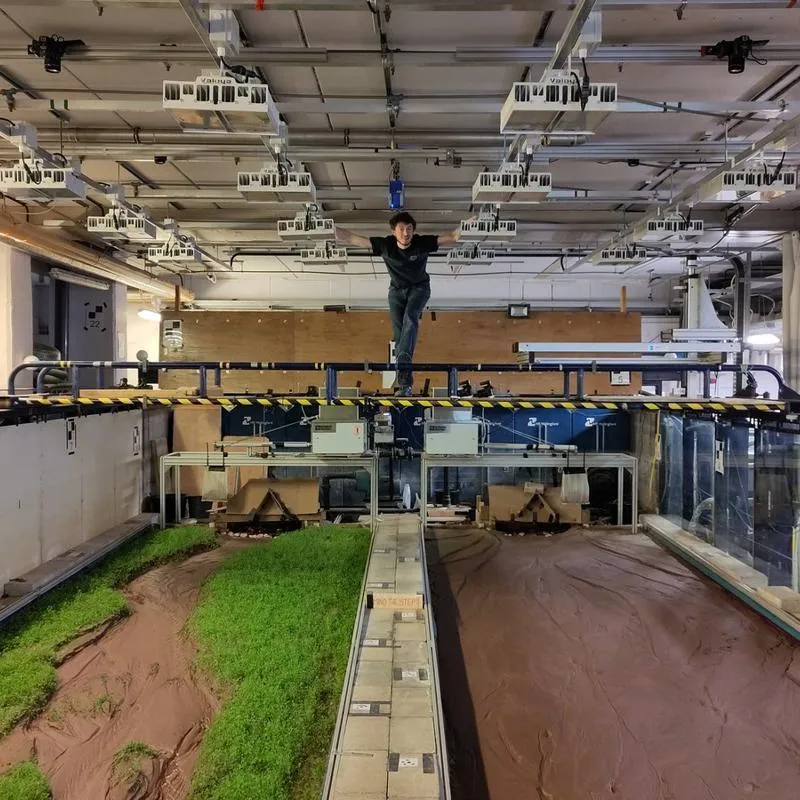
The Total Environment Simulator (TES), based at The Deep, is an experimental facility designed for modelling the movement of water and sediment under a wide range of environmental conditions.
The facility consists of a flume tank where experiments are conducted using apparatus to control the movement of water and sediment, and an integrated suite of high-resolution monitoring equipment to measure process rates and the shape of developing landforms.
The facility is owned and managed by the University of Hull and is available for both research and developmental projects to both industry and academia.
The Total Environment Simulator (TES) is designed to provide a flexible modelling environment that can be configured to simulate a wide variety of environmental conditions - from seabeds on Earth to hillslopes on Mars.
Designed for modelling sediment transport and flow dynamics under a range of environmental conditions, flow can be produced using three different mechanisms; unidirectional currents, waves and rainfall. An integrated suite of high-resolution monitoring equipment is also available for measuring fluid dynamics and sediment fluxes.
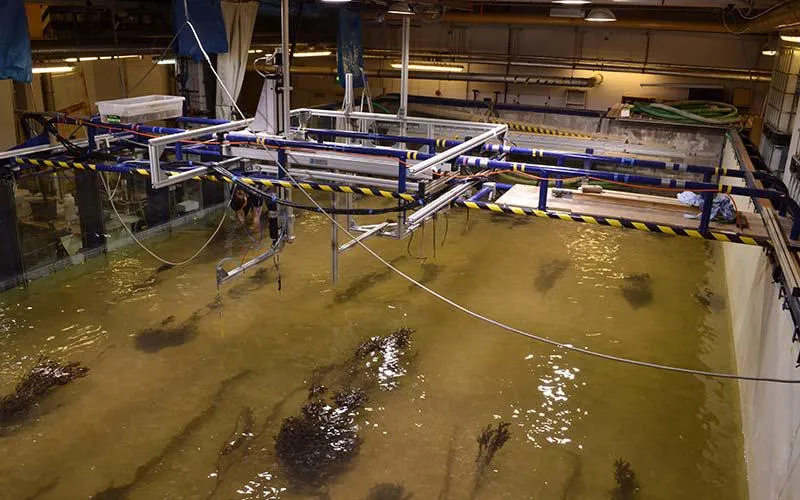
The need for physical modelling facilities like the TES has never been greater. Global climate models predict, at continental scale, changes in the patterns of temperature, rainfall and wind. For the UK there is a prediction of increased storminess, and recent adverse weather events which have caused widespread flooding in many of our major towns and cities have been interpreted as the consequences of global climate change.
In spite of our increasing ability to produce predictive models at a global scale, we are far from translating these models into local and regional scale predictions. Yet this is the scale at which individuals and societies are beginning to feel the adverse effects.
In addition, the impact of mankind on the aquatic environment is increasing as population grows. Water is central to sustainable development and managing water resources effectively and efficiently is a growing imperative. The physical modelling capabilities of the TES allow us to derive data to calibrate and validate the mathematical models that are the foundation of future prediction.
The TES is particularly suited to modelling flood events. We have been able to simulate the effect of flooding on a river channel system and with the addition of the rainfall generator we can study the effect of a rainstorm on river levels. This allows us to examine how water reaches the river channel from slopes surrounding the channel, which improves our understanding of how the effects of flooding can be minimised and how water levels in a river channel can be controlled.
Predicting the movement sediment, particularly erosion, is essential for effective environmental management. The flume allows scientists to investigate how sediment, from large gravel through to mud, is transported under controlled conditions by simulating the effect of flow, waves and rainfall on mudflat development. This means the facility is able to model and help predict future changes in our environment and understand the key processes that drive environmental change.

For more information, or to discuss use of the TES facilities, contact Prof Stuart McLelland.