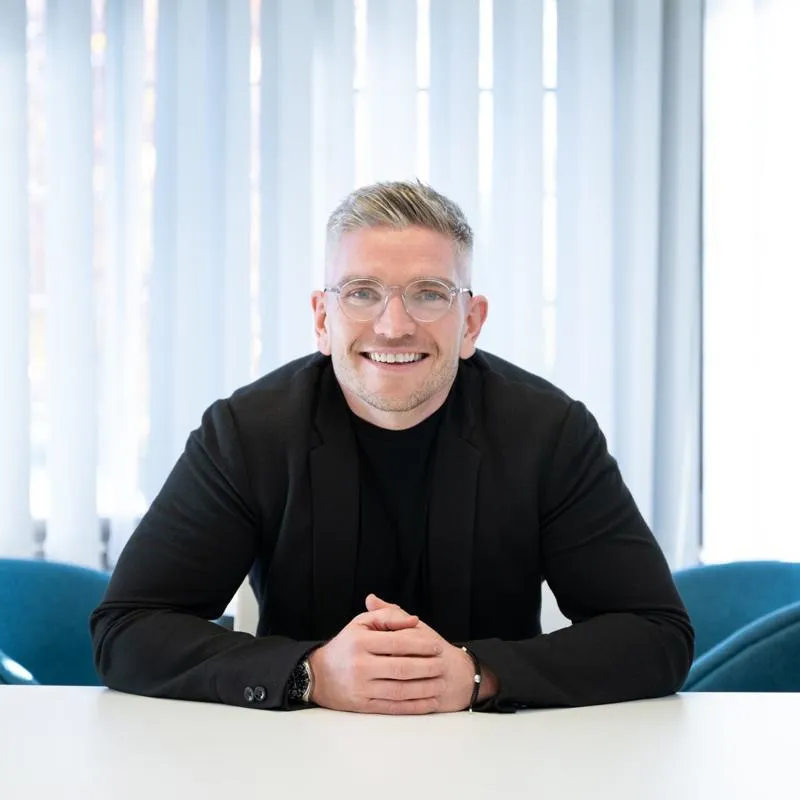
Tell us a bit about how you made the decisions that got you to the University of Hull
I grew up in Harrow in Northwest London. My dad was a taxi driver, and we had a really good life, but things didn’t come particularly easy. I wasn’t the best-behaved kid in school and I could easily have fallen through the cracks. But a couple of people made a huge difference to me and the way I thought at the time.
The first one was my English teacher at secondary school. She took me under her wing; gave me a book she thought I would be interested in and showed me that she believed in me. Maths had always come easily to me, but English had always felt like a slog. Because of that teacher, I ended up getting a B in English. It’s the grade I’m most proud of, because it was the most unexpected.
The other person who changed my thinking at a really important time was my dad. When I was applying to universities, I wanted to be a primary school teacher. My dad sat me down and we talked about my dream life, he got me to visualise my future house, my future car, my future lifestyle. My ambitions then were pretty modest, just like my environment at the time, but my dad worked out what a primary school teacher earns, how much it would cost me to have my dream life and there was a big mismatch between the two. I had an uncle at the time who was an accountant and who was doing alright for himself, so I decided to give accountancy a go myself.
If I’m honest, Hull wasn’t my first choice of university. During the application process, I thought of it as my back-up option. But as soon as I visited, I knew it was where I wanted to go. I fell in love with the place. For me, it was exactly what a university should be. I loved the single campus, and the people were so friendly I felt at home straight away. By the time A level Results Day rolled around, Hull was my top choice and I’m really happy I went there.
University quickly showed me there were so many possibilities beyond the traditional career paths we often see when we’re growing up.
So, you were heading to the University of Hull to study Accounting, but your CV doesn’t really look like an accountant’s CV. Can you tell us more about your career?
I’ve always been a petrol head. And university quickly showed me there were so many possibilities beyond the traditional career paths we often see when we’re growing up.
When I was selecting modules, I started adding in financial management and learning more about how businesses operate and how I could make a difference. In my placement year, I got a placement at Vauxhall, which combined my love of cars with the skills I was learning on my course, and I really think of that as my first career step. Work placements are such a great way of getting an understanding of both the world of work and yourself as an employee. Gaining that insight at that stage of my degree really helped me figure out who I was and where I wanted to be.
You graduated a decade ago now. To use some job interview jargon, what do you feel you ‘bring to the table’ in your work?
I have a very niche skill set (calm down, Liam Neeson). Not many people have the experience of working in the motor industry and bringing new products to the market at such a difficult time. My strength is motivating, developing and building strong teams, developing strategy and empowering teams to deliver them. These skills are transferable outside of the motor industry, but I still love cars and if I can use my skills within the motor industry, everyone’s happy.
What’s the best unexpected perk you’ve had since you’ve been working?
It would be easy to sit here and say that buying this car or that watch were the best perks, but in reality, it’s meeting my wife. We met when we both worked for Nissan, and she has her own very successful career. You don’t hear of people meeting their partners the old-fashioned way very much anymore, it’s all online dating now. But meeting my wife is the best thing that has happened to me through work – she’s the one constant in my life that guides me. She’s on maternity leave at the moment, but I’m looking forward to being able to support her when she goes back to work.
It’s important to keep sight of what really matters and not let work make you compromise too much on the things that make you who you are and keep you grounded.
Two highfliers in one household with two children under school age. That must take some juggling!
It does. And I really want to be around more. I feel I have achieved a lot in my career in the last 10 years, and I have developed some really valuable professional skills that will stand me in good stead for the future. At this point, my aims for the next five years are to spend more time with my family and to sell our current house, which we have grown out of, and move into somewhere that feels as though it can be our forever home.
It’s important to keep sight of what really matters and not let work make you compromise too much on the things that make you who you are and keep you grounded.
Does that mean career ambitions are on the back burner?
No, not at all. My career goal was always to be a managing director of an original equipment manufacturer (OEM). I achieved that at 31, but back then, I had to work harder to be taken seriously because of my age. People thought I was too young and therefore must be too inexperienced to have the job I had. But like Michael Owen said, ‘if you’re good enough, you’re old enough’. For me now, it’s less about the job title and more about doing great work leading great people.
I feel the University gave me so much. I really want to give something back.
You’ve been back to the University of Hull recently. Can you tell us about that?
It was such an honour to be invited to be a part of the University of Hull bootcamp. I feel the university gave me so much. I really want to give something back, and if I can do that by influencing and inspiring the current cohort of students, that would be amazing. At uni, you can feel as though everyone else knows exactly what they’re doing and what they want to do. I never felt like that, and I wanted to let the students know that it’s ok not to know. The most important thing they can do is avoid closing any doors, keeping their options open and having as many experiences as possible.
Any final words for our students?
Coming from where I came from, when I started working, I thought that money was everything. I was so driven by it. I remember sitting in a session in my graduate scheme where everyone was talking about why they go to work. People were talking about personal and professional ambitions, what they wanted to learn and how they wanted to apply their skills, but I was still in a money mindset. It has taken time, but I have learned that while money is important, more money doesn’t mean more happiness.
It’s important to not lose sight of what actually matters in life: health, family and longevity. It’s about life achievements, not your bank balance or what you can buy with it. Life’s too short and 100-hour working weeks aren’t sustainable. At some point, you have to prioritise life over work.